Searching for the best marketing content approval tool for your team? Narrowed your options down to three contenders (Gain, Planable, and Later), but aren’t quite sure how they differ?
On the surface, all three tools help you plan content and gather feedback and approvals from stakeholders. But each is built around a slightly different idea of what a marketing team needs.
In this guide, we break down what each tool does well, who it’s for, and what it costs to help you decide which one is the right fit.
Let’s begin!
Gain vs. Planable vs. Later at a Glance
| Tool | Standout feature | Best for | Free trial |
|---|---|---|---|
| Gain | Content approval workflows for every content type — not just social | Marketing teams (in-house or agency) that need fast, accountable sign-off on everything they publish | ✅ 14-day free trial |
| Later | Visual-first scheduling and Link in Bio | Creators and small businesses focused on visual content | ✅ 14-day free trial |
| Planable | Visual content previews | Small teams that want one visual, collaborative calendar | ✅ First 50 posts free |
Overview of Gain
Best for marketing teams that need automated content approvals on different types of marketing assets
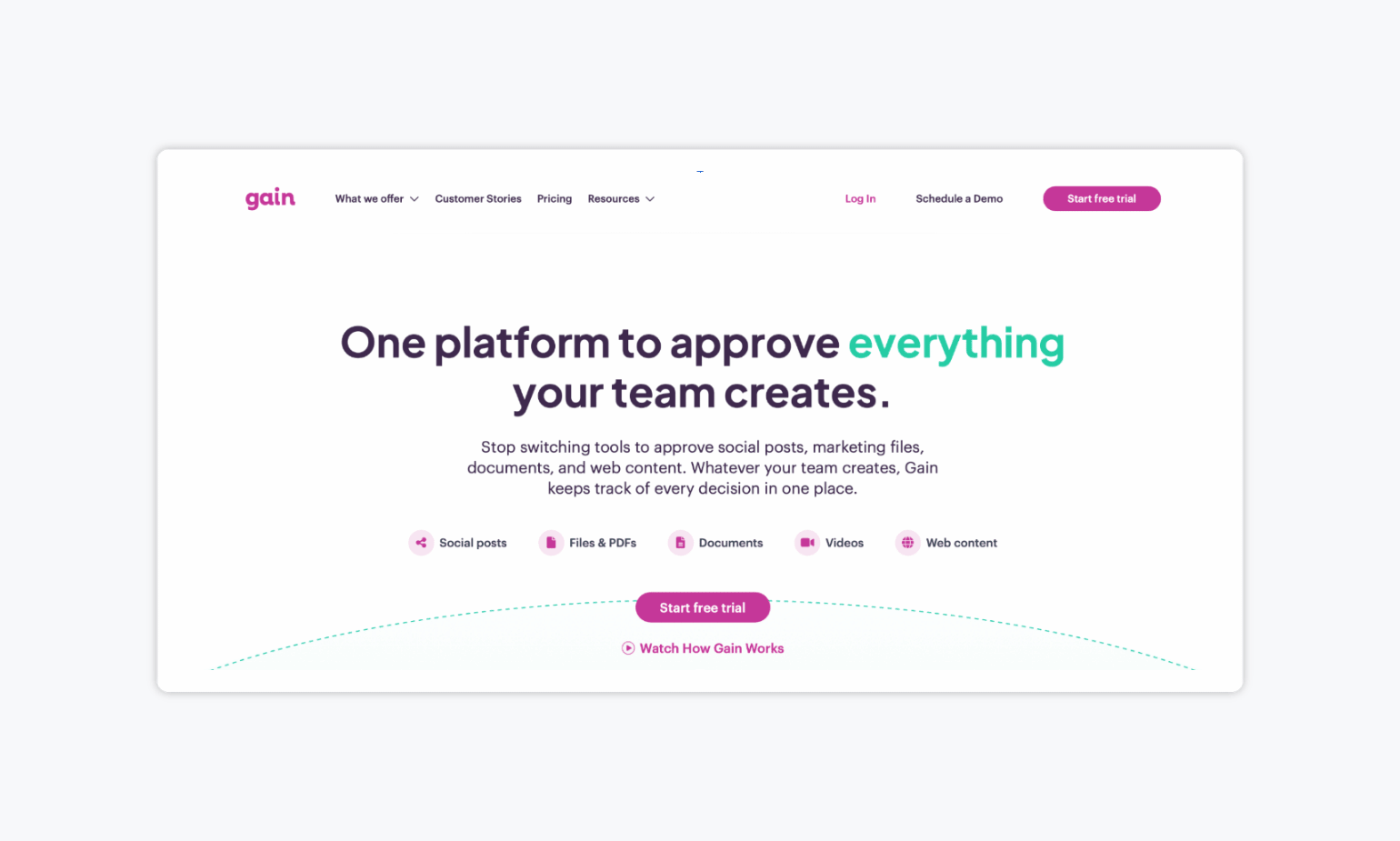
Gain is a content approval and collaboration platform designed to simplify the process of getting marketing content signed off. It is well suited to both in-house marketing teams managing multiple brands and stakeholders and agencies overseeing content for a range of clients.
The platform addresses a common problem: content gets buried in email threads and Slack messages, feedback becomes scattered, and no one is entirely sure which version is final. As a result, approvals are delayed, edits are missed, and content can be published without the proper sign-off.
Approval Workflows
Gain’s core strength is its customizable approval workflows. You can build a review chain with any number of reviewers and rounds, and once the last person approves, content is automatically scheduled and published without you needing to do anything else. Approvers don’t need a Gain account or password; they get a magic login link straight to their inbox and can approve or request changes in one click.
Not Just Social Content
This is where Gain has pulled further ahead of the pack. Every plan lets you send social posts, files, PDFs, documents, spreadsheets, presentations, videos, and any other web content through the exact same approval process. You can leave pinpoint feedback directly on a PDF, mark up a slide deck, or comment on social media posts with a timestamped log of all changes requested.
Content Management & Collaboration
Gain gives every brand or client its own workspace, with its own calendar, folders, and permissions, so nothing gets mixed up across accounts. Within a workspace, you can tag teammates, assign tasks, and see a full activity log of every comment, revision, and approval attached to the content it belongs to.
Pros and Cons of Using Gain
| ✅ Pros | ❌ Cons |
| Approval workflows built for every content type your team produces | Analytics cover core performance metrics (likes, engagement, views, comments); teams that want deep reporting will likely need to pair Gain with a dedicated analytics tool |
| Publishes to 9 social networks: Facebook, Instagram, X, LinkedIn, TikTok, Pinterest, Threads, YouTube, and Google Business Profile | |
| Unlimited reviewers and approval workflows on every plan |
What Users Have to Say about Gain
As of July 2026, Gain holds a 4.7/5 rating on G2, with reviewers consistently pointing to its approval workflows and the time it saves chasing down feedback. One user, Yobana, put it this way:
“We use Gain every day as it streamlines our processes for us. Keeping internal and client approvals all in one place. It helps us stay on top of content and allows us to use API features for social posts. Their customer support is amazing and very responsive.”
Gain Pricing
The Starter plan starts at $99/month (billed annually) with 3 team members and 6 workspaces. Agency ($199/month) adds white labeling and room for 6 team members and 12 workspaces. Agency Premium ($399/month) scales to 20 team members and 30 workspaces. Enterprise offers custom pricing with SSO and contract billing for larger organizations.
Every plan includes unlimited reviewers and unlimited approval workflows, so you’re never paying more just because more people need to weigh in. There’s also a 14-day free trial available with no credit card required.
Overview of Later
Best for creators and small businesses focused on visual-first social media networks
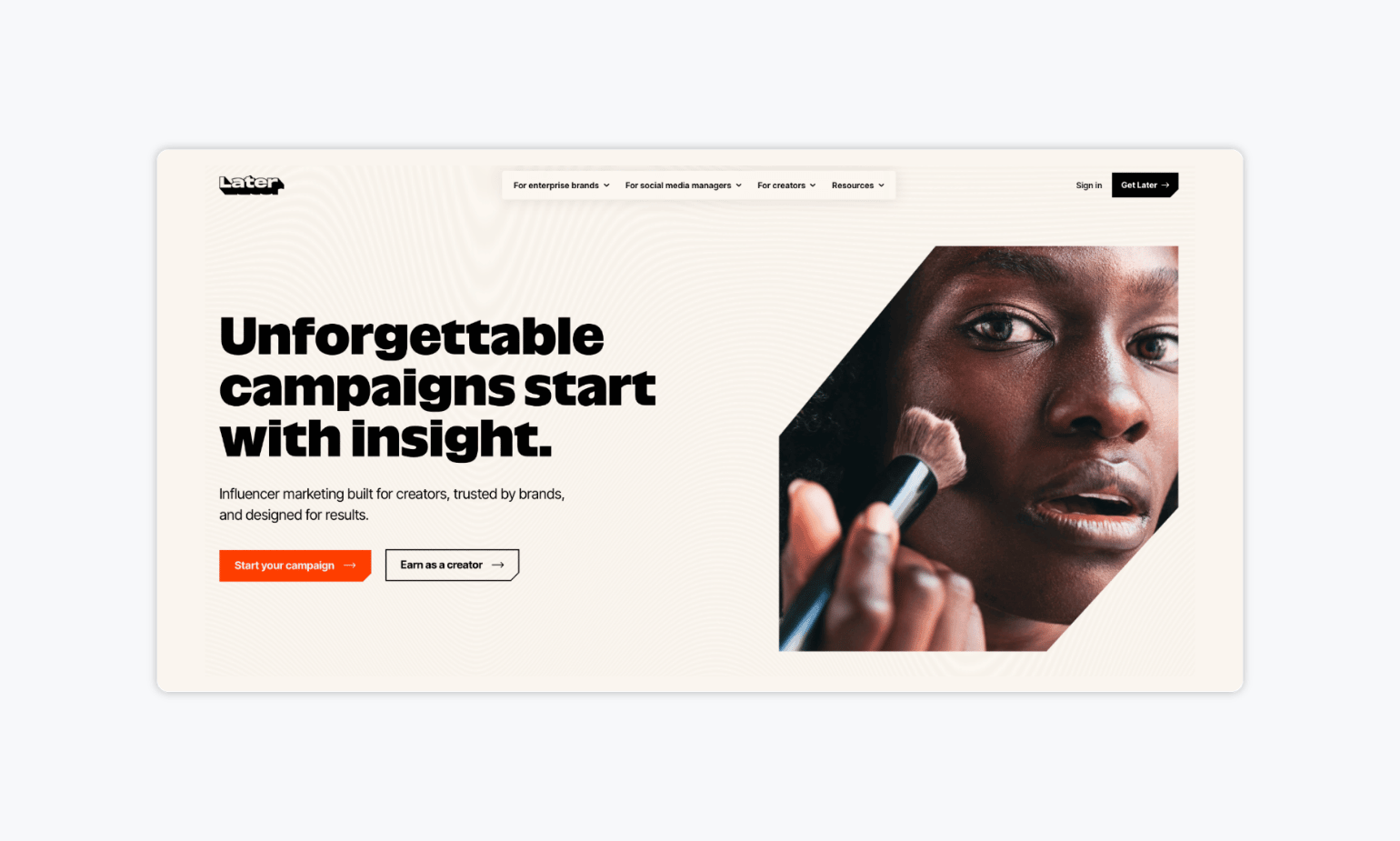
Later solves a narrower problem than Gain or Planable, and it solves it well: making sure your feed is visually curated. Most scheduling tools treat posts as isolated items on a calendar. Later treats them as pieces of a grid, so you can see how a caption, a color palette, or a Reel cover sits next to everything around it before it goes live.
Scheduling & Visual Planning
Later’s Visual Planner covers Instagram, Facebook, TikTok, Threads, Pinterest, LinkedIn, YouTube, and Snapchat, with drag-and-drop grid previews so you can see how a post fits your feed before it goes live. You can bulk-schedule content and let Later auto-publish Reels, Stories, and carousels.
Content Approvals
Content moves through Later’s approval flow one post at a time: a user checks “Submit for Approval” in the Post Builder, and any teammate with the Reviewer role can approve it or request changes from a review queue.
Compared to Gain or Planable, which allows extending approvals to other types of content, with Later, you can only get sign-offs on social media posts. And unlike Gain, approval status doesn’t actually block publishing on Later: a scheduled post still goes live at its scheduled time even if it hasn’t been approved, unless someone remembers to save it as a draft instead.
Link in Bio
Later’s Link in Bio tool turns your Instagram and TikTok profiles into shoppable, clickable landing pages, making it one of the platform’s most popular features among creators looking to drive traffic off-platform. If having a Link in Bio is important for your business, Later has a clear advantage over the other two tools compared in this article.
Pros and Cons of Using Later
| ✅ Pros | ❌ Cons |
| Offers a unified inbox that brings comments and DMs from every connected channel into one place | Approval and review tools are lighter than what larger teams or agencies typically need |
| Focuses on visual planning tools | |
| Provides a growing influencer marketing suite (campaign services, a creator network, and AI-powered creator matching) for brands that regularly work with creators |
What Users Have to Say About Later
As of July 2026, Later holds a 4.5/5 rating on G2. Reviews tend to describe it as a strong fit for individual creators, solo marketers, and small businesses managing one or two brands, rather than teams juggling multi-stakeholder reviews.
One user said:
“I like how Later Social keeps me consistent with my posting schedule and gives me the chance to look at my analytics to see what’s performing. The updates it provides inform me on what’s doing well and what’s not working, which is really helpful.”
Later Pricing
Later’s Starter plan runs $18.75/month (billed annually) for 1 user, 1 Social Set (8 profiles), and up to 30 posts per profile per month. Growth ($37.50/month, its most popular tier) doubles that to 2 Social Sets and 2 users, adds batch approvals and a social inbox, and raises the cap to 180 posts per profile. Scale ($82.50/month) unlocks 6 Social Sets, 4 users, unlimited posts, and deeper analytics.
All three tiers include a 14-day free trial.
Overview of Planable
Best for small teams that want a visual, collaborative calendar to cover more than social media content
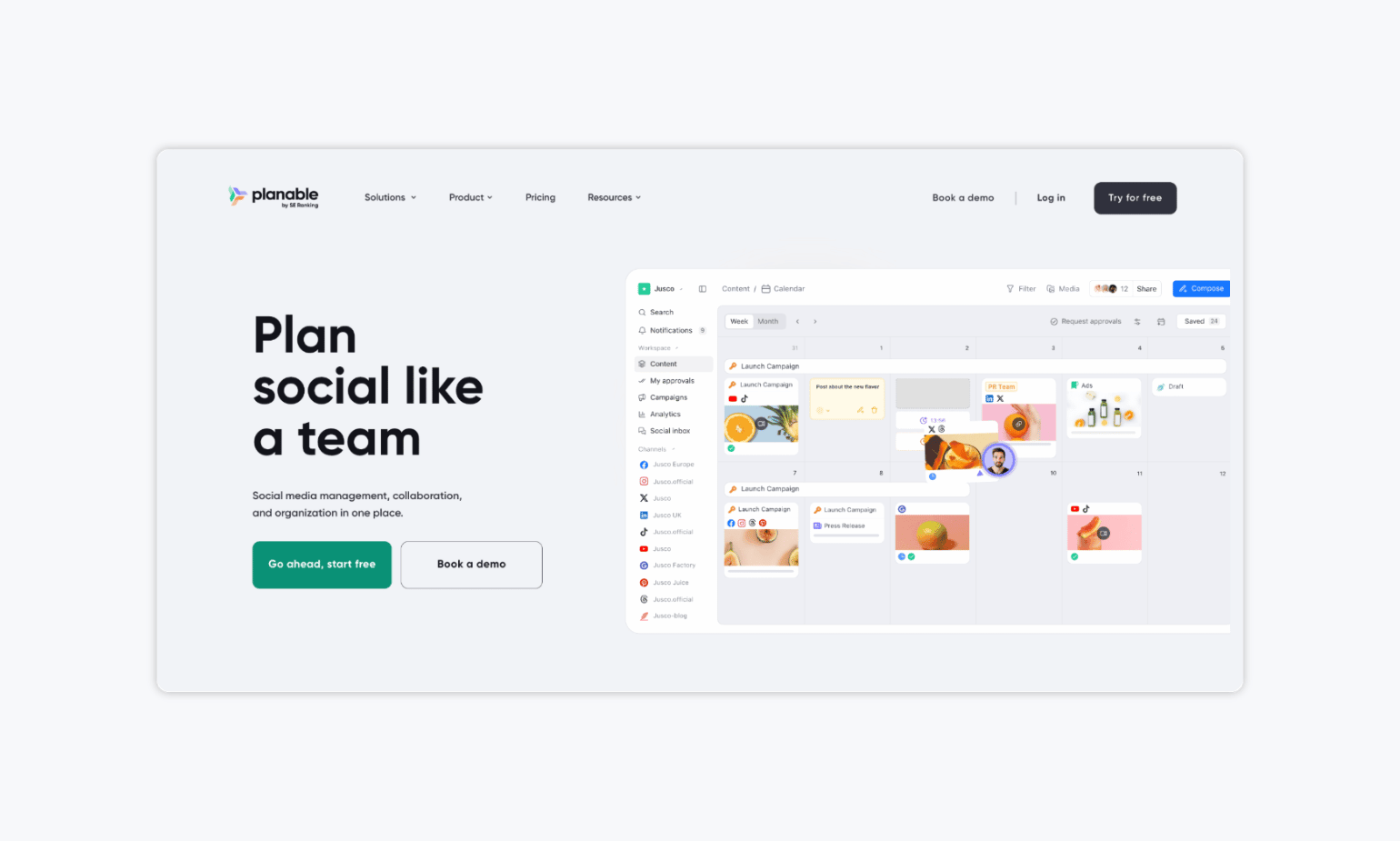
Planable is built around a shared workspace for planning social and marketing content. Content lives in native-looking previews for each platform, with Feed, Calendar, Grid, and List views for looking at a plan however a team needs to. Approvals move step by step through a customizable, kanban-style queue, so nothing gets scheduled without a clear green light.
Approvals & Universal Content
Planable recently extended its approval workflow beyond social with Universal Content, letting teams plan and approve blog drafts, newsletters, ad copy, and press releases alongside their social calendar.
Compared to Gain, though, none of that extends to non-text content. Universal Content doesn’t include native PDF annotation, visual proofing for design files, or live URL previews for web pages yet.
Collaboration
Planable’s collaboration tools cover much of the same ground as Gain’s: teammates can comment, leave annotations and text suggestions, and resolve feedback directly on a post, with roles and permissions controlling who can view, edit, approve, or publish.
Later’s approval tools are thinner by comparison, plus they’re gated to Growth plans and up.
AI & Integrations
Planable leans into AI and third-party connections more than Gain or Later do at this point. Its MCP Connector lets you plug an AI assistant directly into Planable to create and manage content across workspaces, and Pro and Enterprise plans add a public API for custom integrations.
Pros and Cons of Using Planable
| ✅ Pros | ❌ Cons |
| Clean, realistic post previews | Limits non-social content support through Universal Content to text and rich content; there’s no native PDF annotation, visual proofing, or web preview yet |
| Intuitive interface that’s easy to pick up | |
| Connects to AI assistants through an MCP connector, so teams can create and manage content across workspaces without leaving the tools they already use |
What Users Have to Say About Planable
As of July 2026, Planable holds a 4.6/5 rating on G2, with reviewers frequently praising the interface and ease of use. Some reviews note that per-workspace pricing gets expensive for teams running several brands or clients at once.
One user commented:
“What I like best about Planable is how clearly I can see everything I’ve planned. The layout makes it easy to understand my content at a glance, which really helps me stay organized and calm.”
Planable Pricing
Planable’s Basic plan starts at $33 per workspace per month (billed annually) for 60 posts, unlimited users, and 4 social pages. Pro ($49/workspace/month) raises that to 150 posts, 10 social pages, required approvals, and API access, while Enterprise offers custom pricing with unlimited posts, multi-level approvals, SSO, and a dedicated account manager. Analytics and a social inbox are available as paid add-ons on every tier.
Take Your Pick
The right choice between Gain, Planable, and Later comes down to which features your team values most.
If your team is Instagram-first (or focuses more on other visual social media platforms), Later’s visual planner and Link in Bio tool are hard to beat for the price. If you want a clean, collaborative space for planning social content and are starting to bring some of your written marketing content into the same calendar, Planable is a genuinely strong, easy-to-use option.
However, if your marketing team — whether it’s an in-house team coordinating with multiple stakeholders or an agency managing content across several clients — finds that its biggest bottleneck is getting every piece of content approved quickly and maintaining a clear paper trail, Gain is built specifically for that job.
Try Gain for free (no credit card required)!