
According to the Lumency Global Sponsorship and Partnerships Study, nearly half of all major brand owners actively engage in brand-to-brand partnerships to hit their marketing goals. While the stats paint a pretty rosy picture, any marketer who’s ever had to manage a partnership with another brand knows the collaboration isn’t easy.
From aligning on brand voice and claims to keeping two sets of stakeholders working off the same version, there are a lot of moving parts to make it a success. In this blog post, we’ll look at:
- What co-branded content is
- Why brands do such partnerships
- The best ways to get sign-offs from both brands
Let’s begin!
What Is Co-branded Content?
Co-branded content is content that two (or more) brands create and publish together, with both names attached and both parties having a say in what goes out. It’s distinct from sponsorships or paid influencer content, where one brand is essentially paying for reach on someone else’s platform and has limited input into the creative itself.
In co-branded content, both sides are creative partners. That might look like: 👇
- A joint campaign video
- A shared social series
- A co-authored report
- A product collaboration with matching marketing assets
The defining factor is that both brands are equally invested in how the final piece looks, sounds, and represents them.
Why Brands Create Co-branded Content
Brands keep investing in co-branded content for a few reasons:
- Shared audience access. Partnering with another brand puts your content in front of an audience that already trusts a name they recognize, often one that would be expensive or slow to reach on your own.
- Split production cost. Two brands sharing a production budget can afford a bigger, higher-quality campaign than either could justify solo.
- Borrowed credibility. Pairing with the right partner signals something about your own brand. Association does real work, especially when you’re trying to reach a new market or reposition how you’re perceived.
Why Co-branded Content Approvals Break Down
So, despite all the positives co-branded campaigns can deliver, they’re quite difficult to execute. The biggest bottleneck? Content approvals!
Content sign-offs tend to fall apart in the same few ways:
❌ No shared source of truth. Each brand reviews its own copy of a file, sent by email or shared separately. By the time feedback comes back, nobody is looking at the same version anymore.
❌ Unclear ownership of final say. Both brands have opinions, but nobody defined upfront who has veto power versus who’s just weighing in.
❌ Feedback arriving in parallel through different channels. Brand A comments in a shared doc, Brand B replies over email, and someone has to manually reconcile two threads of notes, which is where things get lost.
❌ Version drift. Brand A approves version 3. Brand B is still reviewing version 2 because nobody sent them the latest file, and now there’s an “approved” piece of content that one brand never actually saw.
So how can you overcome all of this? Let’s break it down next!
How to Get Sign-off From Two Brands Without Chaos
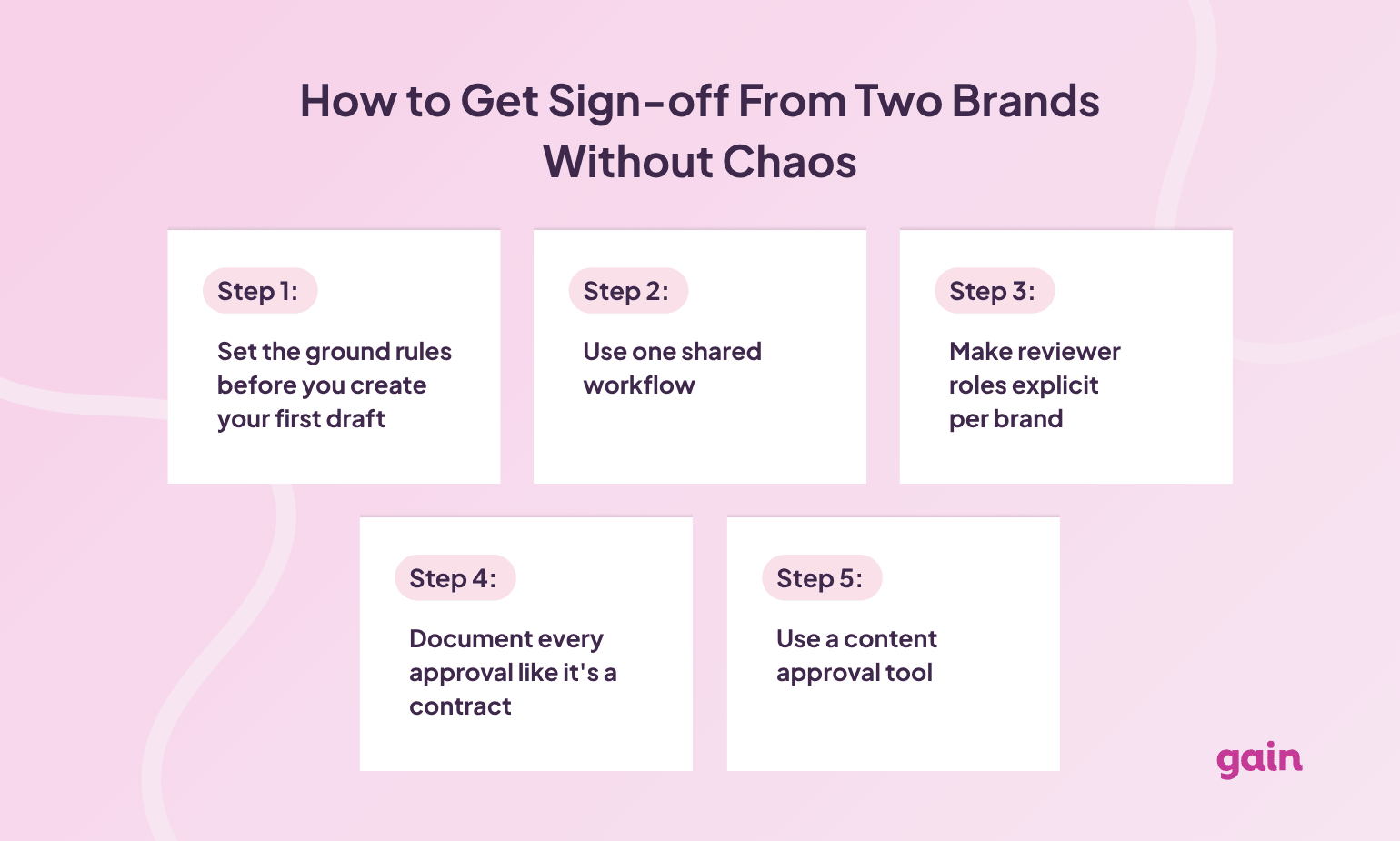
Getting past these breakdowns comes down to a handful of decisions made before content ever gets created.
Set the Ground Rules Before You Create Your First Draft
Most co-branded approval problems trace back to one thing: nobody defined the rules before the content was created. So, as the first step, agree on a few basic things, such as:
- Who has veto power versus who’s providing input only
- What needs joint sign-off versus what either brand can approve independently
- A shared checklist of claims, tone, and visual standards both sides agree to upfront
It’s the same principle behind building compliance into the content process from the start instead of treating review as a last-minute gate, just applied to brand alignment instead of legal risk.
Settling this early means disagreements happen in a planning conversation, not in a comment thread on finished creative.
Use One Shared Workflow
The single biggest fix for version drift and scattered feedback is making sure both brands review the same file, in the same place, at the same time. That means one workflow both sides operate in, not two separate review chains someone has to reconcile by hand.
Each brand should also only see what’s relevant to their side of the partnership, which is where granular, workspace-level permissions matter. Brand A doesn’t need visibility into Brand B’s internal notes, and vice versa, but both need to be looking at the exact same version of the content.
By the same token, you also need to decide upfront whether reviews happen sequentially or in parallel. Sequential works well when one brand’s feedback naturally needs to come first, for example, the brand supplying the core product should confirm accuracy before the partner brand weighs in on presentation. Parallel review is faster when both sides are checking different things and don’t need to see each other’s comments to do it.
Whoever owns the master version should be responsible for merging feedback into it, rather than each brand’s team quietly making edits to their own copy and hoping it lines up later.
Make Reviewer Roles Explicit Per Brand
Each brand should also name one point person with real authority to approve, not a rotating cast of stakeholders weighing in at different stages. Just as important, define what each brand is actually checking for. Brand A might own legal and claims accuracy, while Brand B owns visual identity and tone.
Without a named reviewer, you’ll end up collecting feedback from whoever happens to see it, whether or not they have the authority to request changes.
Document Every Approval Like It’s a Contract
Two brands means two sets of exposure if something goes wrong, and a casual “looks good” in a Slack thread won’t hold up if something needs to be traced back later. At a minimum, you need a clear record of who approved the content, which version they approved, and when. Ideally, all of that information should sit right alongside the content, not buried in emails or Slack threads.
This matters because if a co-branded post gets flagged for a misleading claim, or a partner’s legal team asks who signed off on a specific line, “we talked about it on a call” isn’t really an answer either brand wants to give.
A proper approval record shows exactly which version was approved, by whom, and when. That protects both brands equally, rather than putting one side in the position of taking the other’s word for it.
Use a Content Approval Tool
All of the above is much easier to put into practice with a dedicated content approval tool rather than piecing it together across email, Slack, and shared drives. A content approval tool gives both brands one place to review the same file, assign reviewer roles, and track every comment and sign-off automatically, instead of relying on whoever remembers to loop the other brand in.
For example, with a tool like Gain, both brands can review content from the same shared workspace. Every comment, revision, and approval decision is logged automatically with a name and timestamp, so there’s a clean, traceable record of who signed off on what. When it’s time to publish, only content approved by both sides can go live.
FAQs
You should define ownership in the partnership agreement before content is created, not decided after the fact. Most co-branded agreements specify joint usage rights, with both brands able to publish on their own channels, though exclusivity windows and usage limits vary by deal.
Some of the most famous co-branded campaigns include GoPro and Red Bull, which paired GoPro’s action cameras with Red Bull’s extreme-sports content and audience to create a steady stream of adrenaline-fueled footage. Uber and Spotify let riders control the music during their trip by linking their Spotify account, blending a rideshare app with a personalization feature neither could build solo. And Airbnb and National Geographic co-produced travel storytelling and guides, pairing Airbnb’s local-host access with National Geographic’s editorial credibility and global reach.
Co-branded Campaigns Don’t Have To Be a Pain!
Co-branded content succeeds or fails on process just as much as creative. The campaigns that come together smoothly aren’t the ones with the most talented teams on either side. They’re the ones where both brands agreed on the rules before a single asset was made, worked from one shared version of the truth, and kept a clear record of every decision along the way.
If you’re ready to bring that structure to your next partnership (especially when it comes to content approvals), try Gain for free today.