
If your marketing team uses AI to produce content, it’s always a good idea to check that the output still sounds like your brand. Facts and grammar are easy to catch. Tone isn’t, and it’s usually where AI content starts to drift first.
In this blog, we’ll show you how to build a brand voice review checklist for AI-generated content, so you have something to refer to whenever you need to make sure your content is on-brand.
Why Brand Voice Slips in AI-generated Content
There are several reasons AI content doesn’t sound like you, even if you feed your brand voice guidelines, and that’s mainly because:
- It mimics patterns, not intent. AI can match reading level, average sentence length, and typical structure with real precision. What it can’t reverse-engineer is why your brand phrases things a certain way, so it produces copy that’s structurally correct but semantically generic.
- Nothing about a single draft looks wrong. A single draft may not seem like there’s anything wrong with it. The grammar is clean, the facts are correct, and the tone sounds professional. But that doesn’t always mean it sounds like your brand. In fact, it may sound like it could have come from any company in your industry, and that’s the real problem.
- Existing checklists weren’t built for it. Most content review processes check facts, links, and grammar, all real risks worth catching in AI-generated content. But the brand voice gets treated as a subjective call instead of a checkable item. So when deadlines are tight, it’s usually the first thing that gets skipped.
- Review capacity hasn’t scaled with output. Teams generating far more AI content than before are still running it through processes sized for the old volume. Less time per draft means less attention paid to something as easy to miss as tone.
What You Need Before You Can Build the Checklist
Before you can build a review checklist that’s actually useful, three things need to exist first:
➡️ Reference examples. A small set of real, approved copy, five or six pieces, is usually enough so that reviewers can pattern-match new drafts against. Abstract descriptions like “confident” or “friendly” only become useful once there’s a concrete example attached to them.
➡️ A preferred and banned word list. Every brand leans on certain words and avoids others, and AI has no way of knowing either unless it’s told, repeatedly.
➡️ A defined tone range per channel. “Confident” doesn’t read the same way on LinkedIn as it does in a product email. Define, even if it’s loosely, your channel-specific tone ranges to keep a single standard from being applied everywhere.
What To Include in Your Brand Voice Review Checklist
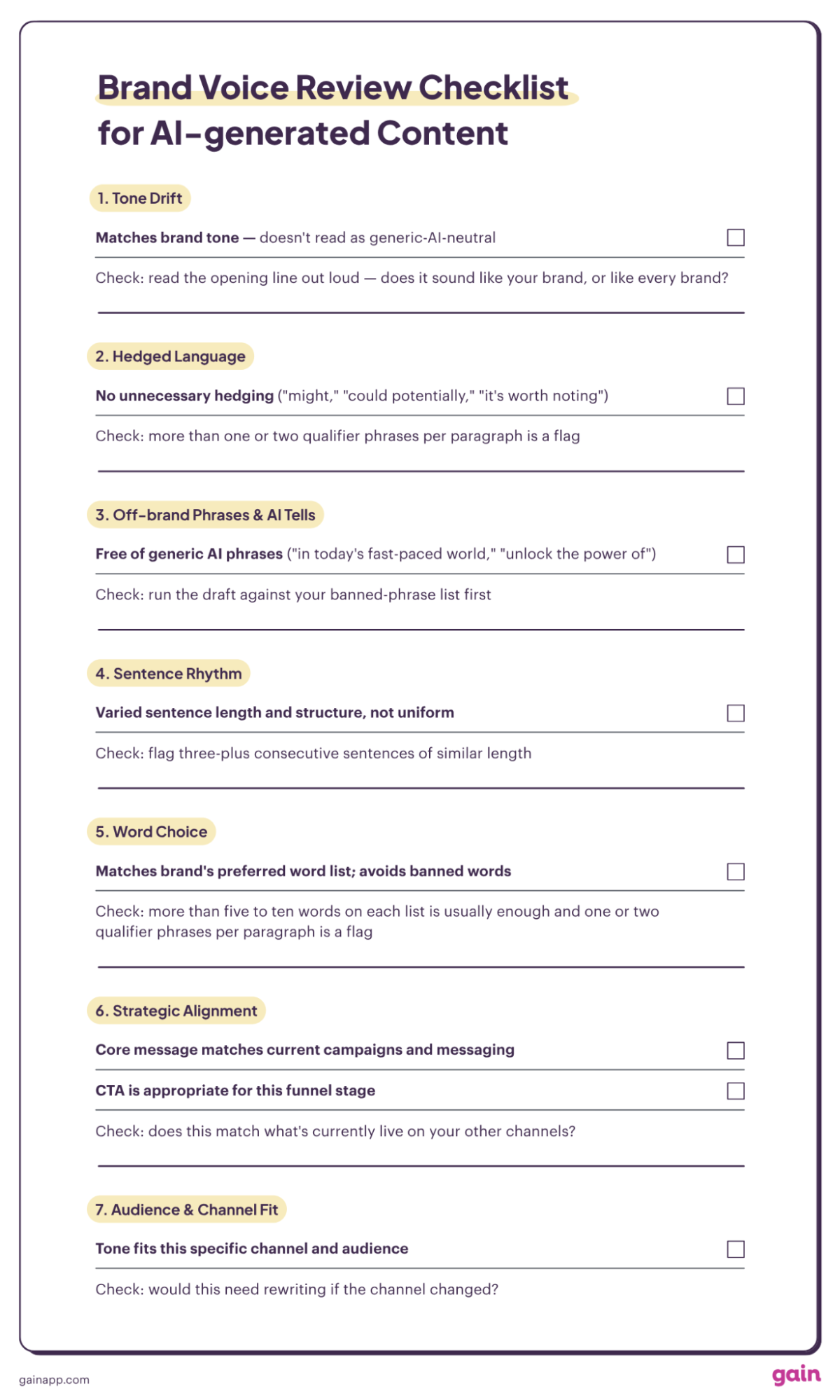
So, what should you include in a brand voice review checklist for AI-generated content? While every brand has its own style and priorities, there are a few core areas that are worth reviewing every time.
Use the checklist below to make sure your content not only reads well but also sounds like your brand.
Tone Drift
Does this draft match the brand’s actual tone, or has it slid toward generic-AI-neutral? A playful brand producing flat, corporate phrasing is tone drift, even if nothing is factually wrong.
Check: Read the copy out loud. Does it sound like your brand, or like every brand?
A good example of a very distinct tone is Ryanair — a budget Irish airline. Ryanair’s social voice is blunt, sarcastic, and self-deprecating. So, if they produce a copy that reads like a polished airline press release, that would fail this check immediately.

Hedged Language
AI defaults to hedging: “might,” “could potentially,” “it’s worth noting.” If your brand voice is decisive, hedging undercuts it.
Check: Count qualifier phrases per paragraph. More than one or two is a flag.
Off-brand Phrases and AI Tells
Certain phrases show up in AI drafts across every brand and industry: “in today’s fast-paced world,” “unlock the power of.” No brand voice should own generic phrases like these.
Check: Keep a running banned-phrase list and search the draft against it first.
Sentence Rhythm
AI tends to produce sentences of similar length and structure, one after another. Real brand voices usually have intentional variation, a short, punchy line after a longer one, for example. Uniform rhythm is a tell, even when every sentence is individually fine.
Check: Scan for three-plus consecutive sentences of similar length.
Word Choice Against Your Lists
Every brand has words it leans on and words it avoids. AI doesn’t know either unless told, and it forgets by the next draft.
Check: Match the draft against a short preferred/avoid word list.
Strategic Alignment
A draft can be perfectly on-voice and still off-strategy: the wrong CTA for this funnel stage, a claim outside current messaging. Voice and strategy are different checks, and AI can pass one while failing the other.
Check: Does the core message match what’s currently live on your other channels?
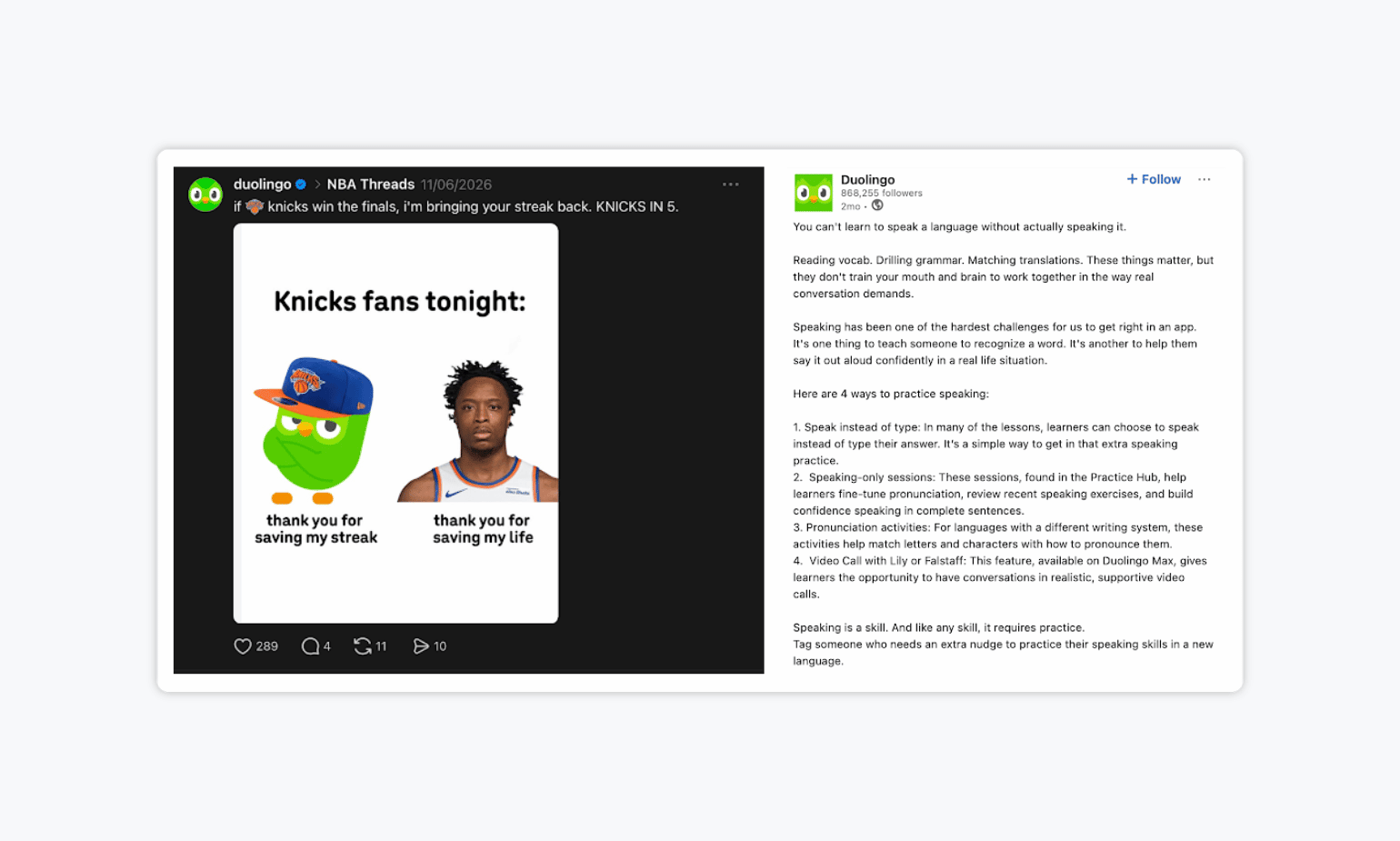
Audience and Channel Fit
A brand doesn’t sound identical on LinkedIn and TikTok, even with a consistent underlying voice. AI often applies one tone uniformly unless prompted otherwise.
Check: Would this need rewriting if you swapped the channel, or does it already fit?
If you take Duolingo as an example, on Threads, it’s playful and irreverent, closer to a friend teasing you than to a brand posting updates. On LinkedIn, that same personality shows up in a more measured, professional tone, though still they don’t shy away from their humorous tone.
Brand Voice Review Checklist for AI-generated Content
Where This Checklist Fits Into Your Overall Content Approval Process
A brand voice checklist works best as one step in a broader AI content approval process, alongside fact-checking and final sign-off. But even a good checklist won’t help if your marketing team has a messy content approval process in general.
That’s where Gain can help. Gain is a marketing content approval tool that allows you to centralize approvals for everything your team creates, including social posts, files, documents, and web content, in a single workspace, instead of spreading them across Slack, email, and shared docs.
You can build the brand voice check directly into your approval workflow as one of the steps, so nothing moves to sign-off until it’s been reviewed against the checklist. Your reviewers get notified automatically when something’s waiting on them, and every decision is logged next to the content, so you always know exactly what was checked, by whom, and when.
FAQs
A style guide is the reference document that explains your brand’s writing rules, including tone of voice, grammar preferences, formatting, terminology, and messaging. A brand voice checklist is a practical tool reviewers use before publishing, containing things that need to be checked to ensure your content sounds like your brand.
A fact-check pass verifies accuracy: statistics, names, dates, and claims. A brand voice checklist checks fit: does this sound like your brand, strategically and tonally? A draft can pass one and fail the other, which is why most teams run both, usually at different stages of review.
Final Thoughts
AI can (sort of) write in your voice. But it can’t own your voice. That’s still the job of the review process (and humans on your team) to catch drift before it reaches your audience.
Gain helps you bring every content approval into one place, so brand voice checks happen consistently, not just when someone remembers to run them.