Image via Magnific
We can all agree that AI has made content production faster. And it’s no secret that companies of all sizes now use it to brainstorm, draft, repurpose, and fill content calendars at a pace that wasn’t possible before.
But publishing AI-generated content without a proper review process? That carries its own risks. Hallucinated facts, brand voice drift, unapproved claims, the wrong version going out — these don’t fix themselves. And a quick skim from one person isn’t a content approval process.
What teams actually need is a structured checklist and a clear sequence of who checks what before anything goes live. That’s what we’ll cover in this blog post.
Why AI Content Needs Its Own Approval Process
Traditional content goes through one main risk: did a human write something wrong? With AI-generated content, the risk profile is different.
AI can produce text that reads polished and confident while being factually incorrect. It can nail a paragraph’s structure while drifting completely from your brand voice. It can generate a version of the content that’s close to, but not quite, what the brief asked for — and it will never tell you.
There’s also the version problem. AI drafts get iterated quickly. By the time content reaches a reviewer, it’s not always clear which version they’re looking at, or what changed between rounds.
Teams that leverage AI for social media at scale are already running into this. The output is fast; the accountability isn’t. This is why AI-generated content can’t just be dropped into the same approval process as human-written content. It needs its own checklist, and ideally, a structured sequence of who reviews what and when.
The Three-tier Content Review Workflow
There are a gazillion different ways you can set up your content review workflow. Ultimately, it depends on what sort of content you create, who’s involved in the approval process, and what makes sense for your business.
However, if you’re looking for a simple framework to start with, here’s a three-tier review workflow you can use: 👇
Tier 1: The AI Quality Pass
This is the first gate, and it happens before anyone else sees the content.
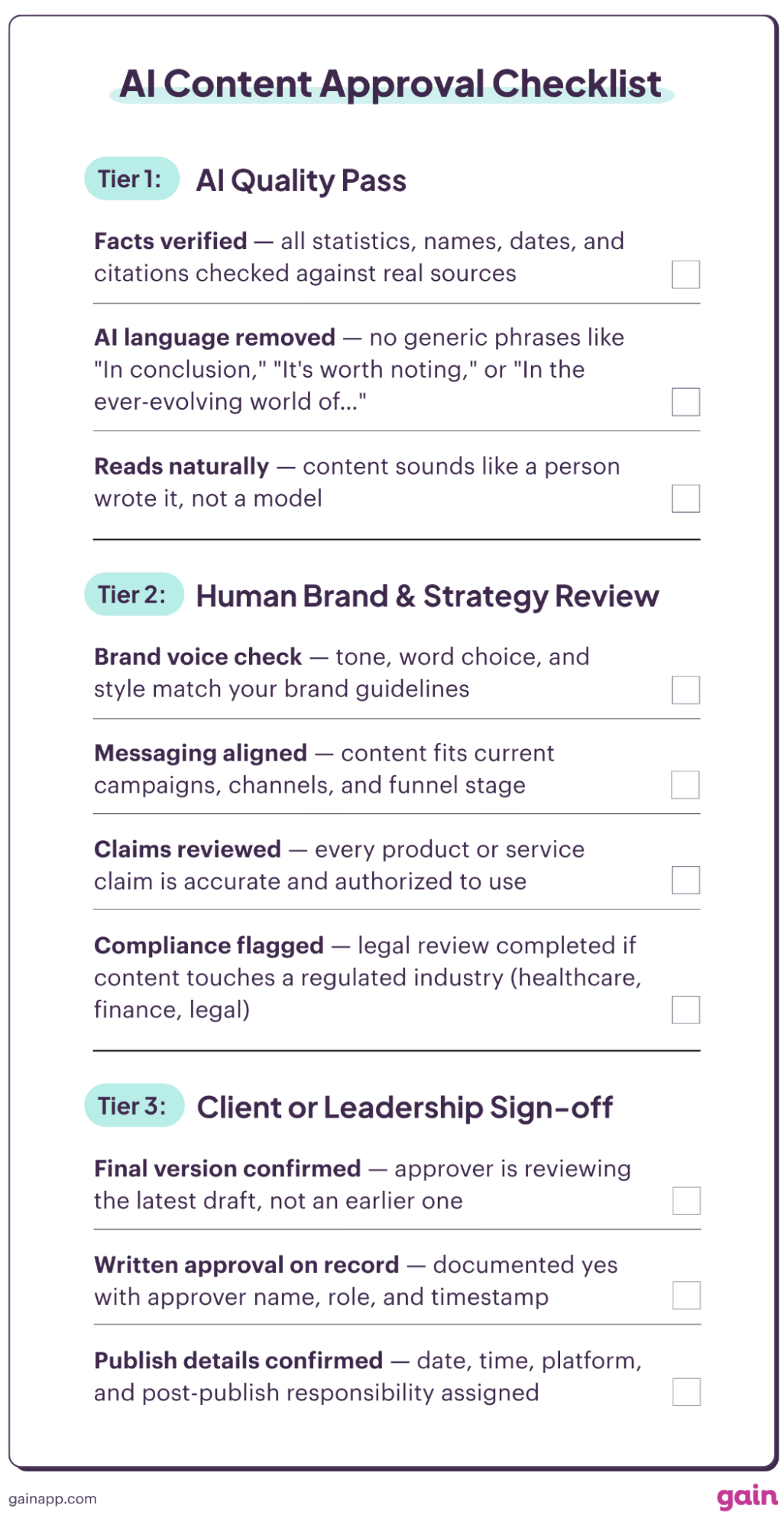
The job here is to clean up what the AI got wrong or left incomplete. That means checking every fact the AI included (statistics, dates, names, citations), and verifying them against real sources. AI models are fluent and confident, which makes hallucinated details especially easy to miss on a quick read.
This is also where AI-specific language gets removed. You know the phrases: “In conclusion,” “It’s worth noting,” “In the ever-evolving world of marketing.” These make content sound generic and templated. Part of the Tier 1 pass is reading for naturalness — does this actually sound like something a person wrote?
Who owns it: The content creator or an AI-specialist editor.
Tier 2: Human Brand and Strategy Review
This is where the content gets held up against your brand.
Brand voice is the big one. AI is good at mimicking a general tone, but it doesn’t know your brand well enough to catch the subtle things: a word choice that feels off, a joke that doesn’t land the way your brand would land it, a headline that’s technically fine but somehow isn’t you. This tier requires a human who knows your brand inside-out.
Beyond voice, this tier looks at messaging alignment. For example:
- Does this content fit what you’re saying right now across your other channels?
- Is the CTA appropriate for where this piece sits in the funnel?
- Are there any claims in here that need a second look from a legal or compliance standpoint?
This is also the moment to confirm that links work, assets are on-brand, and any product or service claim in the copy is something you’re actually authorized to make. AI doesn’t know the difference between an approved claim and one that’s still in legal review.
One thing worth calling out here: if you’re working in a regulated industry, such as healthcare, finance, legal, this tier carries extra weight. Social media compliance requirements don’t have an exception for AI-generated content. The fact that a tool wrote it doesn’t reduce your liability if something inaccurate or non-compliant goes out. In regulated spaces, legal review at this stage isn’t optional.
Who owns it: A brand manager, senior editor, or strategist.
Tier 3: Client or Leadership Sign-off
This is the final gate, and the most important one to get right. The failure mode here is subtle: the client or stakeholder says “looks good” in a Slack message, and that becomes the approval. Two weeks later, something in the post becomes a problem, and nobody can trace who approved what version or when.
At this stage, the most important thing is to get a documented “yes” on the right version of the asset and with a clear record of who gave it and when. It means the approval needs to live somewhere trackable.
This tier also assigns post-publish responsibility: who’s checking that the content went live correctly and that nothing needs to be addressed after it does?
Who owns it: The client contact, account lead, or department head — whoever has final authority over what goes out.
AI Content Approval Checklist
To make this easier, we built a ready-to-use checklist based on the three-tier model above. Grab it below and adapt it to your team.👇
What Makes This Actually Work
A checklist is only as useful as the system behind it. If it lives in a Google Doc that reviewers have to remember to open, it’s going to get skipped. If content approvals are scattered across email, Slack, and comments in different tools, nobody has a full picture of where something stands.
The teams that make this work are the ones where the checklist is built into the workflow — where content moves through review stages automatically, where approvers get notified instead of chased, and where there’s a clear record of who approved what and when.
That’s exactly what Gain is built for. Instead of managing approval rounds through emails and messages, Gain lets you build customizable approval workflows where content moves through each review round automatically. Every stakeholder involved gets notified via email when there’s an asset waiting for them. And every approval decision is documented right next to the content, so you always have a clear paper trail of who approved what and when.
Wrapping Up
AI-generated content works best when there’s a human system wrapped around it. But keeping that system consistent, especially across multiple clients or campaigns, is easier said than done without the right infrastructure.
If your team is publishing AI content at any meaningful volume, a structured approval process is non-negotiable. Try Gain today to set it up and see how much easier it is to publish content that’s been properly reviewed, approved, and documented every step of the way.