Creating content is a process that involves many people: clients, content marketers, copywriters, designers, managers, legal reviewers, and more. Every one of them adds a communication layer and another set of deadlines to uphold. And quite frankly, for a lot of marketing teams, that’s where things break.
In this guide, you’ll learn how to self-diagnose whether your content approval process is broken — and how to fix it once and for all.
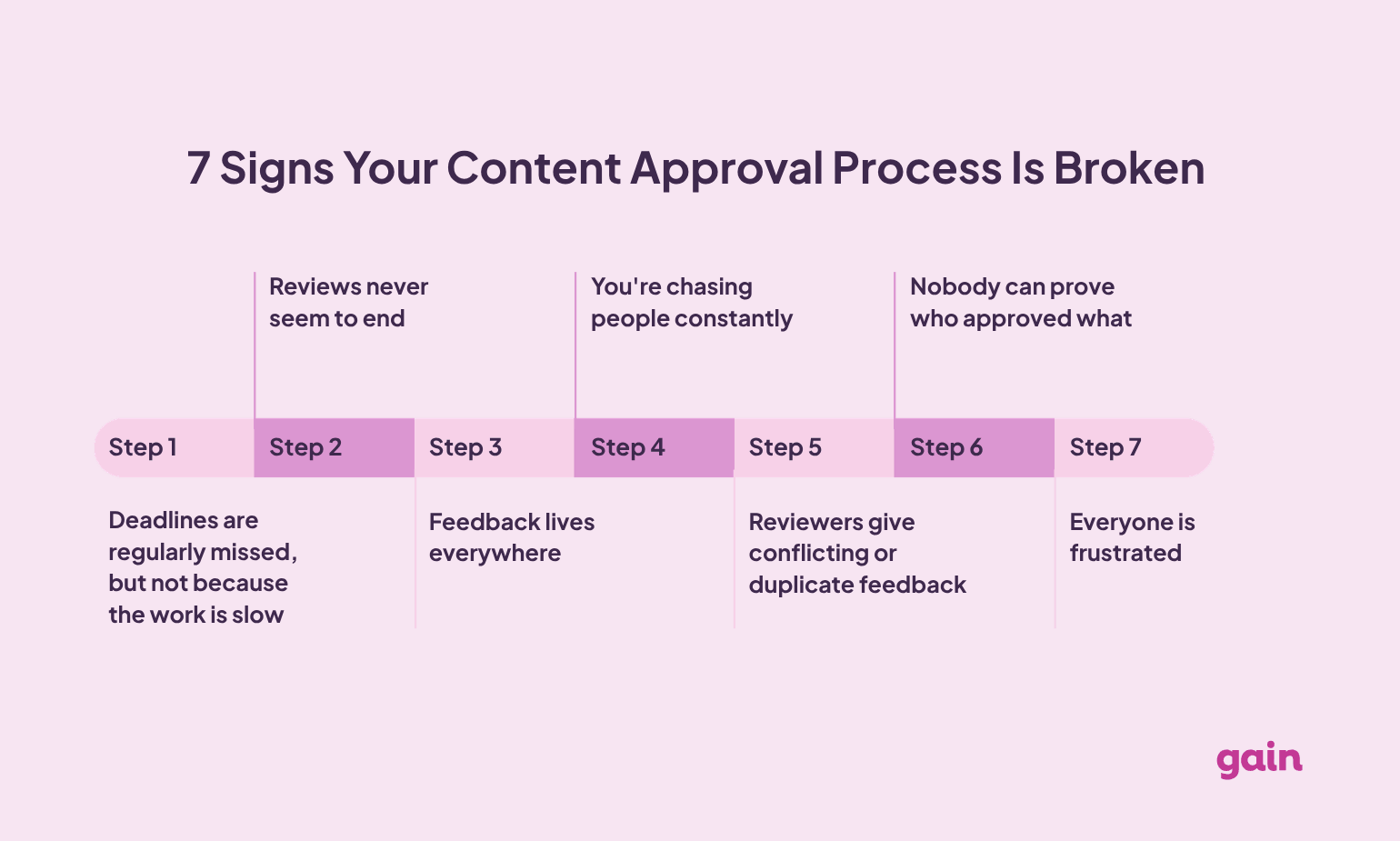
7 Signs Your Content Approval Process Is Broken
So, how do you know if your content approval process isn’t working as it should? There are a few telltale signs:👇
1. Deadlines Are Regularly Missed, But Not Because the Work Is Slow
Missed deadlines are the most common symptom of a broken approval process, and also the most misdiagnosed one. When content keeps shipping late, the natural assumption is that the work is taking too long. But in most marketing teams, that’s not what’s happening.
The copy was ready Tuesday, the design was done Wednesday, and the post still went out four days late. The delay comes from everything around the work: the draft sits in someone’s inbox for two days, comes back with feedback, gets fixed within the hour, then waits again for the next person to look at it. Add up all that waiting, and it’s often longer than the time it took to create the content in the first place. So if your team hits their deadlines but content still ships late, your schedule is leaking at the review stage.
2. Reviews Never Seem to End
Endless review cycles is another symptom of a broken content review process. They’re caused by the absence of a defined endpoint: no agreed “approval of record” that closes the loop.
When nobody has formally decided which round is final and whose sign-off counts as the decision, any stakeholder can reopen the discussion at any time, and every reopening invites others to relitigate feedback that was already resolved. Review rounds expand to fill the absence of a decision-maker. If you can’t answer “whose approval makes this final?” in one sentence, this is your problem.
3. Feedback lives everywhere
Nothing says “broken review process” quite like feedback that literally lives everywhere. By that we mean drips and drabs of feedback and edit requests scattered across Slack, email, meeting notes, and whatever else people use to fire off a quick thought. Some of it gets implemented, some of it gets forgotten, and some of it refers to a version of the file that’s three edits old by now. That’s how the same change gets requested twice, and how a designer ends up carefully polishing the wrong version.
4. You’re Chasing People Constantly
If “Just checking in on this!” is the most-used phrase in your outbox, you already know something’s off. In a lot of teams, content only moves because an account manager or project manager keeps pushing it: forwarding files, reminding the client, asking legal if they’ve had a chance to look. That’s hours of every week spent on follow-ups. And it means your whole publishing schedule depends on one person’s persistence.
5. Reviewers Give Conflicting or Duplicate Feedback
Another warning sign is a lack of visibility that leads to conflicting or duplicate feedback. When reviewers work in silos, each responding in a separate email thread, they can’t see what others have already said. As a result, they may repeat the same points or give contradictory instructions.
Even worse, two reviewers may provide genuinely conflicting feedback without a clear hierarchy for deciding whose input takes priority. This leaves the content creator stuck in the middle, trying to resolve disagreements between stakeholders.
Ideally, you should define the review workflow, responsibilities, and approval hierarchy before any content is created. That way, everyone knows who is responsible for what and whose feedback takes precedence.
6. Nobody Can Prove Who Approved What
An approval really has two jobs: getting content cleared to go live, and leaving proof, aka timestamped record, that it was cleared. Most teams only ever do the first. A thumbs-up in Slack or a “looks good!” in an email keeps the work moving. But if you work in regulated industries like finance or healthcare, having a proper paper trail of who approved what is key.
7. Everyone is Frustrated
The culmination of a truly broken review process is how the people inside it feel about it. If your team and your clients are constantly frustrated, if nobody quite understands how things are flowing, where a piece of content currently stands, who has it, or what’s supposed to happen next, then you have all the proof you need that your process is due for a revamp.
How to Fix a Broken Content Approval Process
Alright, if you’ve been nodding along while reading the symptoms above, you’re probably wondering what the solution is. Luckily, there are a few things you can do.
1. Start With a Briefing
One of the best steps you can take to get your content approval process organized is to start with a high-level briefing before you start creating content. By sharing the strategy and goals that should guide the content, you help get everyone on the same page from the start. Then, when each person is reviewing the content during their turn, the vision will be aligned, and you’ll avoid wasting time on off-topic ideas or adjustments.
A good brief covers the goal, the audience, the key message, and any non-negotiables like mandatory disclosures or brand rules. It’s also the right place to spell out what each reviewer is actually expected to check.
2. Define Responsibilities
Each person should know their role in the content review process and the order in which they’ll review the content. Some people will be in charge of providing suggestions to the team, while others, like clients, will give directions that must be implemented. Ensuring that everyone knows their function and the roles of others helps smooth out the process and settles in advance whose feedback wins when two reviewers disagree.
An important part of defining responsibilities is limiting editing access to avoid a too-many-cooks-in-the-kitchen situation. When anyone can make changes to the content, you run a higher risk of making mistakes. Reviewers review; creators edit.
3. Map Out Your Workflow
It’s easy to get caught up in a lot of back-and-forth content reviews. A client requests a change, the copy editor rewords it, the SEO team swaps the keywords, and after all of that, it goes back to the client, who requests yet another change. This cycle can seem endless and frustrating.
By mapping out the content approval workflow, you keep things moving and know at any given point where a holdup has occurred or what needs to happen next. Write down the path each content type takes: who reviews first, who’s next, and whose approval is final. Different content types can take different paths. A routine social post might need two sign-offs, while a campaign for a regulated client might need five, in a strict order.
4. Use a Content Approval Tool
You can implement the first three fixes fairly quickly, but you may also need to consider investing in a tool that makes the entire process easier to manage. A dedicated content approval tool is what helps the process stick, and that’s exactly what Gain is built for: one platform where teams can review and approve everything they create, from social posts and files to documents, videos, and web content.

Gain helps you:
- Track everything in one place. Gain tracks when changes are made to content, and by whom. Conversations live next to the content itself, so everyone can see what decisions have already been made before they review or edit.
- Automate reminders and handoffs. Once someone completes their work, they submit it for review and Gain notifies the next person that their input is required, then sends friendly reminders if things stall. Approvers get a magic login link and can approve with one click, no account or password needed.
- Keep a record of every decision. Gain keeps a complete, timestamped history of every revision, change request, and approval, and nothing goes live without the right sign-offs. For teams in regulated industries, that audit trail is essential.
FAQs
A content review is the feedback stage, where stakeholders leave comments, suggest edits, or request changes. Content approval is the final decision that a specific version is ready to publish. Reviewers help improve the content, while approvers have the authority to clear it. A good workflow should clearly define who can provide feedback and who has the final say.
o speed up the content approval process, define the workflow before work begins. Decide who needs to review the content, what each person is responsible for, and who has final approval. Keep all feedback in one place, set clear deadlines, and limit unnecessary reviewers. Using a content approval tool like Gain can also help by centralizing comments, automating reminders, and making it easier to track revisions and approvals in one place.
A Better Content Approval Process Starts With Better Tools
If your team is regularly spending their time on repetitive tasks and tracking down feedback about content, take a step back and review your content review process. A disorganized workflow leads to inefficient work and frustration, and it’s well worth the time to restructure your process.
Gain is a content approval platform that allows you to route every piece of content through a defined approval workflow before anything gets published, keep a complete record of every approval decision, and ensure nothing goes live until the right people have signed off.
Try Gain for free today!