Ask a marketing team how many tools they use and you’ll probably get a guesstimate. Most teams have never counted. The scheduler, the design tool, the proofing tool, the feedback tool, and the spreadsheet someone built in 2022 all got added one at a time.
And the total adds up. In this post, we pulled together nine stats on how much marketing stacks have grown, how little of them teams actually use, and why more software hasn’t made content approvals any simpler.
9 marketing tool statistics to know going into 2027
- There are 15,505 martech products to choose from. The State of Martech 2026 landscape (Chiefmartec, May 6, 2026) counts a whopping 15,505 commercial martech products, up from 15,384 in the 2025 landscape (May 6, 2025) and 14,106 the year before. The market also churns: 1,488 products were added and 1,367 were removed in the latest year, so tools you pick today may not be around in two years.
- Marketers used about a third of their martech capabilities in 2023. In Gartner’s 2023 Marketing Technology Survey, marketers said they used only 33% of the features in their tools, down from 58% in 2020 and 42% in 2022, according to Chiefmartec (August 28, 2023). These are self-reported answers. Marketing Week reports that Gartner’s 2025 survey found marketers using 49% of their stack, so the gap is narrowing, but half of what teams pay for is still sitting idle.
- Tool overlap is the top barrier to using martech fully. In Gartner’s 2022 survey of 324 marketers, 30% named overlap between tools as the biggest barrier, ahead of recruiting talent to drive adoption (28%) and ecosystem complexity (27%), as reported by Chief Marketer (October 21, 2022).
- More than half of marketers added to their stack in a single year. In the 2024 MarTech Replacement Survey, 57% of marketers said the number of applications in their stack rose by one to five that year, according to Bain & Company (December 10, 2025). In another MarTech survey cited in the same piece, 66% of respondents said they can’t measure the effect of their systems.
- The average company manages 305 SaaS applications, and leaves 36% of its licenses unused. Zylo’s 2026 SaaS Management Index puts the average portfolio at 305 applications, and its January 29, 2026 announcement says organizations leave an average of 36% of their SaaS licenses unused. These figures cover all departments, not just marketing.
- Business teams, not IT, control most software spend. Also in Zylo’s January 29, 2026 announcement: business units control 81% of SaaS spend, while IT directly manages 15%. When separate teams buy their own tools, nobody sees the whole picture.
- More than half of software buyers skip IT’s review. According to G2’s 2023 Buyer Behavior Report, 54% of software buyers purchase software their IT team hasn’t vetted, as cited in a G2 article (June 13, 2024).
- The average marketer uses three tools a week, even when the team subscribes to many more. In a March 2024 survey of about 100 marketing professionals, G2 found that 12% of organizations subscribed to 10 or more marketing tools, and the average marketer used 3 tools weekly (same G2 article).
- Half of martech leaders say their stack isn’t ready for what’s next. In Gartner’s 2025 Martech Survey of 413 martech leaders, fielded June through August 2025, 81% were piloting or had implemented AI agents, and half said their organizations lack the technical and data stack readiness to deploy them (Gartner press release, October 29, 2025). AI agents could add yet another layer to the stack.
What this means for content approvals
The number of tools isn’t the real cost. The handoffs between them are.
Think about one campaign. The social captions get approved in a scheduler. The PDF gets marked up in a proofing tool. The video gets notes in a feedback tool, and the landing page gets a screenshot with arrows on it. Each tool has its own logins, its own comments, and its own approval history. So before anything goes live, the campaign has moved through three or four systems, and someone has to remember which one holds the final answer.
That’s where the stats above hurt. Overlapping tools mean the same feedback gets collected in more than one place. Idle licenses mean you’re paying for features nobody uses. And when business teams buy their own tools, nobody owns the approval record. The cost shows up in time spent chasing feedback, but more importantly, in mistakes: the version that went live wasn’t the version that was approved.
How Gain reduces the number of tools you need for content approvals
Gain is a content approval platform built to replace that stack of disconnected tools. Social posts, files like PDFs, videos, images and presentations, text documents, and web pages all go through the same approval flow, so you don’t need a separate tool for each one.
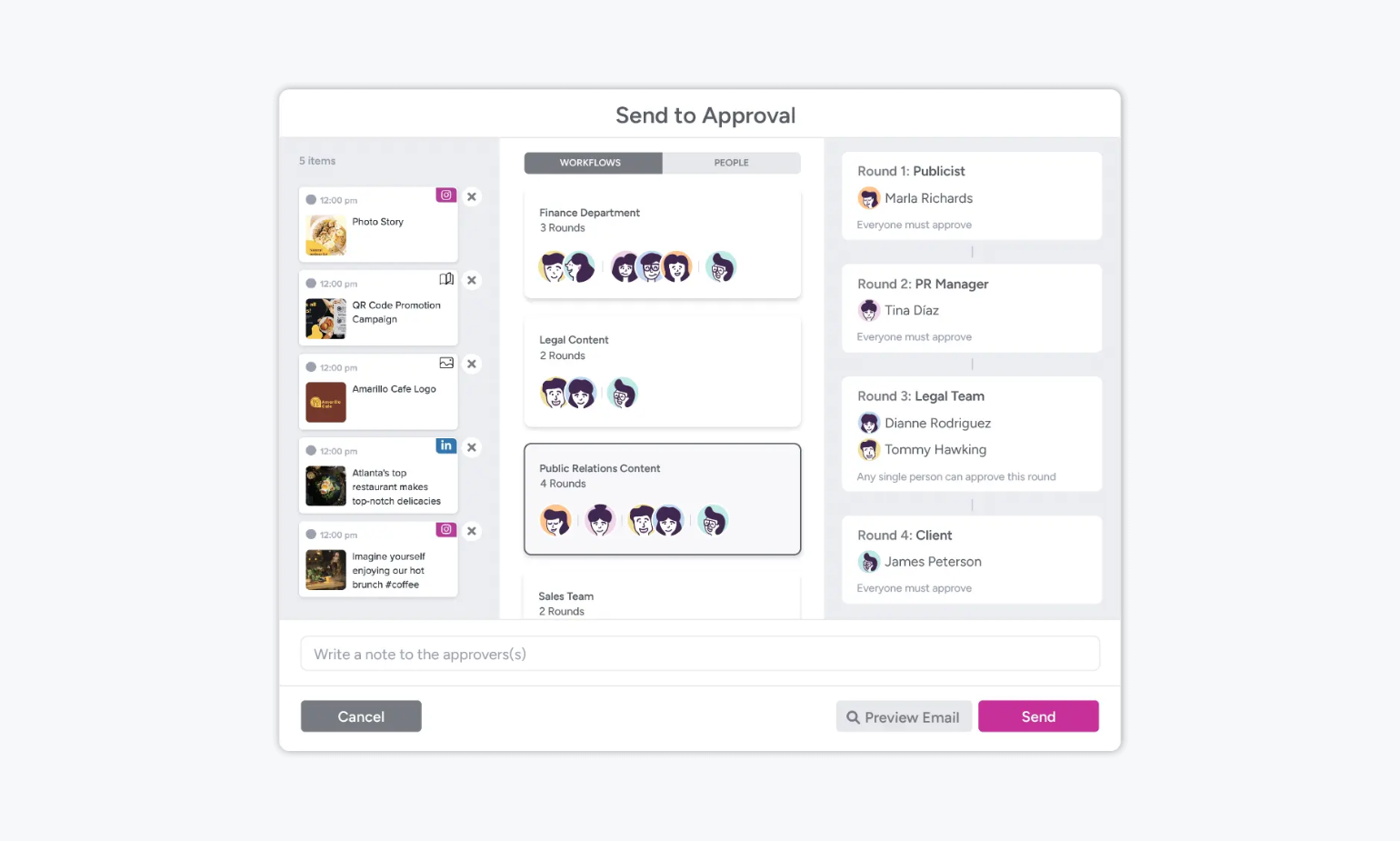
- One place for feedback and approvals. Your team and your clients review everything together, instead of across a scheduler, a proofing tool, and a feedback tool.
- One record. Every approval is time-stamped and tied to a version across all content types, so “who approved this?” has one answer.
- Publishing once approved. Approved social posts can be scheduled and published to 9 platforms, so only signed-off content goes out.
- Flat pricing. Plans start at $99 a month, with unlimited reviewers, approval workflows, workspaces, and social channels.
To be clear, Gain is built for content approvals, not for design, analytics, or detailed markup. But if approvals are the part of your stack that’s scattered across the most tools, that’s the part it replaces. For more on how the options compare, see our roundup of the best content approval tools, and our guide to managing marketing feedback loops. If you’re weighing your options, see our list of the best Filestage alternatives and the best tools for gathering marketing feedback.
Fewer tools, fewer places to hunt for content approvals ✅
No one can give you the exact number of tools on the average marketing team, but the research points the same way: there are more products every year, teams use only part of what they pay for, and the stack keeps growing anyway.
If your approvals run through more than one tool, that’s the place to simplify first. Gain gives you one approval flow and one record for social posts, files, documents, and web pages. Plans start at $99 a month, with unlimited reviewers, approval workflows, workspaces, and social channels.
Want fewer tools between a draft and a green light? Try Gain free.