
Most marketing teams have figured out how to use AI to speed up content production. Far fewer have figured out what to tell people about it.
That gap is becoming expensive. The FTC now penalizes undisclosed AI involvement in advertising at up to $53,088 per post. And according to a 2026 Canva study, 52% of consumers say that disclosure of AI use is one of the key things that builds trust in a brand.
If your team doesn’t have a written policy for when and how to disclose AI use in content, this guide will walk you through building one.
What Is an AI Content Disclosure Policy?
An AI content disclosure policy is a document that defines when your team must communicate AI involvement in published content, to whom that communication goes, what level of human review is required before anything is disclosed or published, and how those decisions are recorded.
Why Should You Have an AI Content Policy In Place?
75% of marketers have already adopted AI in their workflows, according to Salesforce. With marketing teams using the technology more than ever, the question of what to tell clients, audiences, and regulators about that use is no longer optional.
Without a clear policy in place, your team is making disclosure decisions inconsistently, often not at all. That creates real risk:
- Legal exposure: Regulators are actively enforcing AI disclosure requirements, and the penalties for non-compliance are significant.
- Client trust: Clients discovering AI use after the fact damages relationships faster than disclosing it upfront ever would.
- Brand reputation: Consumers are paying attention to how brands use AI, and transparency is increasingly what separates trusted brands from ones that get called out.
So what does a solid AI content disclosure policy actually include? Here is how to build one from scratch.
How to Create an AI Content Disclosure Policy Step by Step
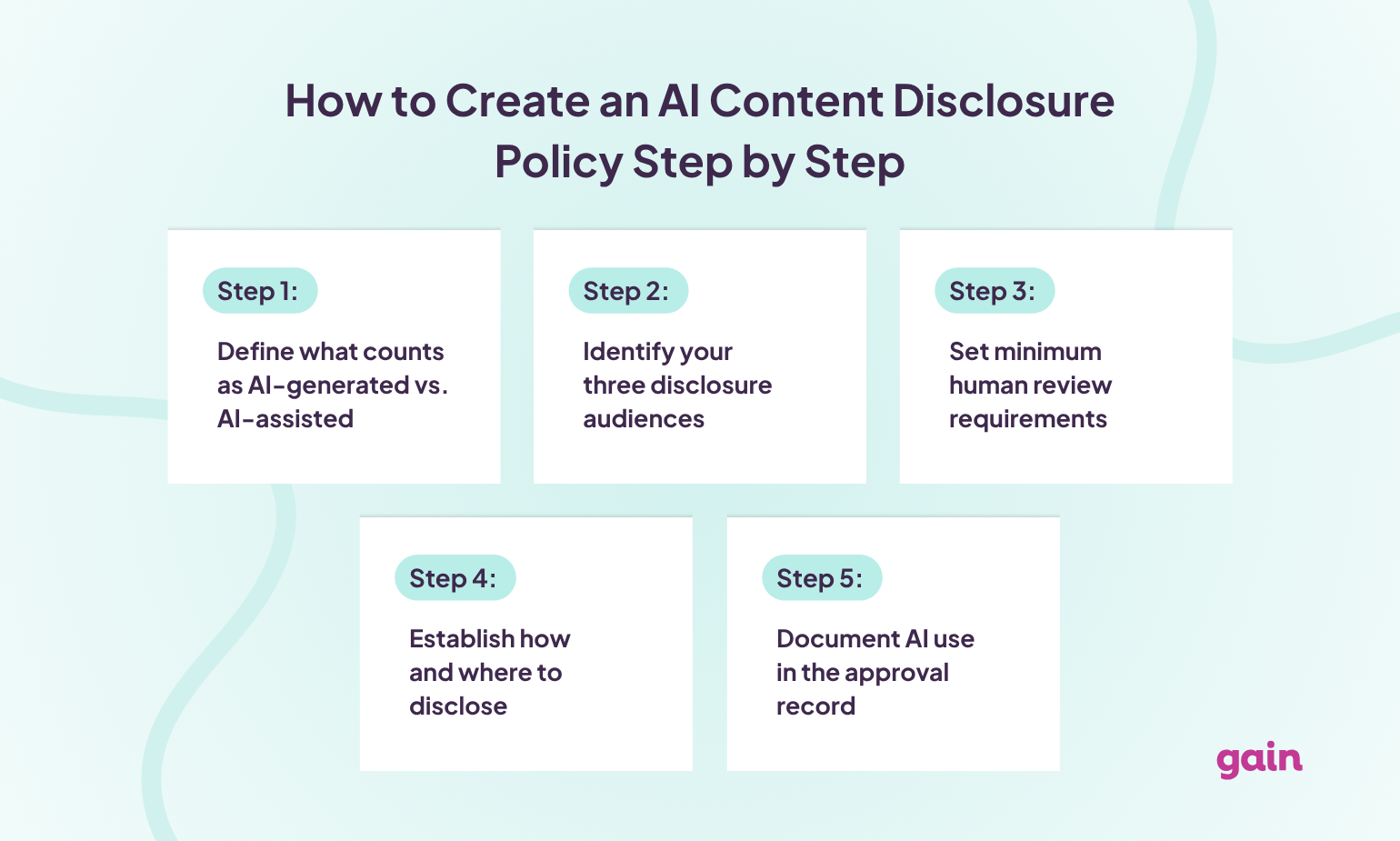
Step 1: Define What Counts as AI-generated vs. AI-assisted
The first thing your policy needs is a shared definition of what triggers disclosure. Without this, you will get inconsistent decisions across team members and no defensible standard if a regulator or client asks.
A practical starting point is the distinction between two categories:
- AI-generated content: AI produced the substantive output, including the copy, image, script, or video, and a human made only light edits or formatting changes.
- AI-assisted content: A human produced the core work, and AI was used in a supporting role, such as research, outlines, rephrasing, or grammar checks.
Your policy should specify:
- Which category requires external public disclosure
- Which requires internal documentation only
- Which falls below the threshold for either
A first draft written entirely by an AI model and lightly edited is in a different category than a human-written article that ran through a grammar tool. The policy needs to make that distinction explicit.
Step 2: Identify Your Three Disclosure Audiences
Disclosure requirements aren’t the same for every situation. Your policy should address three audiences separately:👇
1. Audiences and the public
This covers blogs, social posts, ads, videos, and any brand-published content. The FTC currently requires disclosure when AI was materially involved in creating sponsored content, testimonials, or content featuring synthetic personas. For non-sponsored content, voluntary disclosure is increasingly expected and protects against reputational risk if AI use is discovered later.
2. Clients
Agencies working on behalf of clients have a separate obligation. Many client contracts now include clauses about AI use, and that trend is accelerating. Even where contracts don’t include anything about AI use, failing to disclose AI involvement is a fast way to damage a client relationship. Your policy should specify whether AI use requires proactive disclosure to clients, at what stage of the project, and in what format.
3. Regulators
Teams in financial services, healthcare, pharma, or legal face scrutiny from sector-specific regulators beyond the FTC. For these industries, any AI-generated content should require a compliance review before publication, separate from the standard editorial process.
Step 3: Set Minimum Human Review Requirements
Disclosure isn’t a substitute for review. A disclosure label on a piece of AI-generated content that contains errors, compliance issues, or brand inconsistencies doesn’t protect you. The two requirements work in parallel.
Your policy should tie review requirements to content type and risk level:
- Routine content (social posts, newsletters, blog articles): Single editor review covering accuracy, brand voice, and tone
- Higher-visibility content (paid ads, executive thought leadership, campaign landing pages): Two-stage review including subject matter expert sign-off
- Regulated content (any content in financial, healthcare, legal, or pharma categories): Mandatory compliance or legal review before publication, regardless of AI involvement
❗One important principle: the review standard should never get lowered because a disclosure label is being added. Disclosed AI content invites more scrutiny, not less.
Step 4: Establish How and Where to Disclose
Once your team knows when to disclose, they need to know how. The FTC’s standard is clear and conspicuous, meaning disclosure must be visible without effort. Buried footnotes and small-print labels don’t qualify.
Practical guidelines to include in your policy:
- Written content: Disclosure statement at the top or bottom of the piece
- Social posts: In the caption, not a comment
- Video content: On screen early enough to be read, not only at the end
- Client deliverables: A standard note in the delivery email or project management system
Your policy should also include approved disclosure language so every team member uses consistent wording. A line like “This content was created with the assistance of AI and reviewed by a human editor” is clear, accurate, and legally defensible. Avoid vague phrases like “AI-powered” or “AI-enhanced” that don’t tell the reader what was actually generated.
Step 5: Document AI Use in the Approval Record
This is the most overlooked step, and the one that matters most when you actually need to prove compliance.
When a regulator or client asks whether AI was used in a specific piece of content, “we think so, but we’re not sure” is not an acceptable answer. Every piece of content that goes through your approval process should have a record that captures:
- Whether AI was used and in what capacity
- What level of human review took place
- Whether disclosure was required and what language was used
- Who gave final sign-off and when
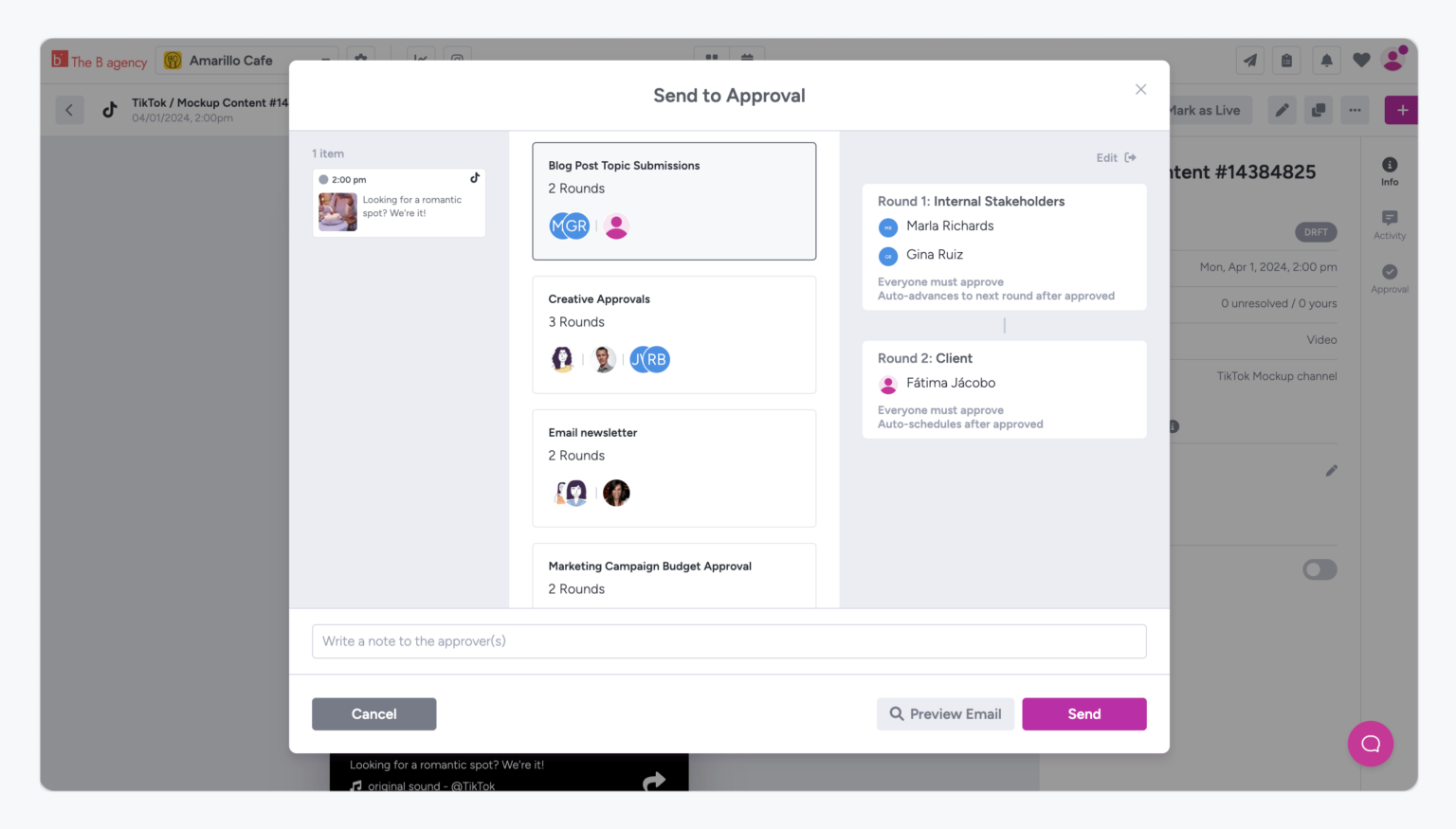
If your approval process runs through email chains or informal sign-offs, none of that information is reliably captured. A structured content approval workflow that routes content through defined stages, requires reviewers to confirm compliance steps, and logs every decision with a timestamp gives you exactly what you need when questions arise.
Gain is a content approval platform that allows marketing teams to build these documentation requirements directly into the workflow. Every piece of content moves through review stages you define, with a complete, timestamped record of who approved what and when.
FAQs
Not necessarily. The threshold for public disclosure generally applies when AI played a material role in creating the content, particularly for sponsored content, paid ads, or synthetic personas. Content where AI was used in a supporting role and a human produced the substantive work typically does not require external disclosure, though internal documentation is still good practice.
Usually, an AI usage policy governs how your team uses AI tools internally, covering approved tools, data privacy, and acceptable use cases. Meanwhile, a disclosure policy governs what you communicate externally about that use. It’s a good idea to have both in place.
The Policy Is the Easy Part. The Process Is What Protects You.
Knowing when to disclose AI use is one thing. Having a system that ensures it actually happens consistently, across every piece of content and every team member, is another.
With a written policy in place, you have a set of rules and a foundation for making the right call every time. If you want to make sure those decisions are also documented, Gain is a content approval platform that keeps a complete record of every review and sign-off across all your content.