Healthcare, pharma, and medical device companies operate under some of the strictest marketing rules of any industry, and regulators are watching closely. In 2025 alone, the FDA sent thousands of warning letters over misleading drug ads, and the FTC sued a major telehealth brand over deceptive billing claims.
A single overstated claim, an unauthorized patient photo, or a sloppy influencer partnership can turn into a lawsuit, a six- or seven-figure penalty, or a huge trust problem.
In this guide, you’ll learn where the biggest healthcare marketing compliance risks tend to arise and how to build an approval process that catches potential issues before content goes live.
What Is Healthcare Marketing Compliance, and Why Does It Matter?
Healthcare marketing compliance is the practice of making sure every ad, social media post, blog post, or other promotional material meets the legal standards for your industry before it goes live.
In the US, that usually means satisfying the Food and Drug Administration (FDA), the Federal Trade Commission (FTC), and the Health Insurance Portability and Accountability Act (HIPAA) at once. Other countries have their own regulators, but the obligation is the same: claims must be truthful, substantiated, and made without compromising patient privacy.
Publishing compliant content matters because regulators actively monitor healthcare advertising and social media, and enforcement has only intensified, from FDA warning letters to FTC lawsuits with multimillion-dollar penalties attached.
Beyond the legal exposure, healthcare marketing influences people making real decisions about their health. Misleading them with unsubstantiated claims can put patients at risk, undermine trust in your brand, and cause reputational damage that lasts long after the campaign ends.
Common Issues That Arise in Healthcare Marketing
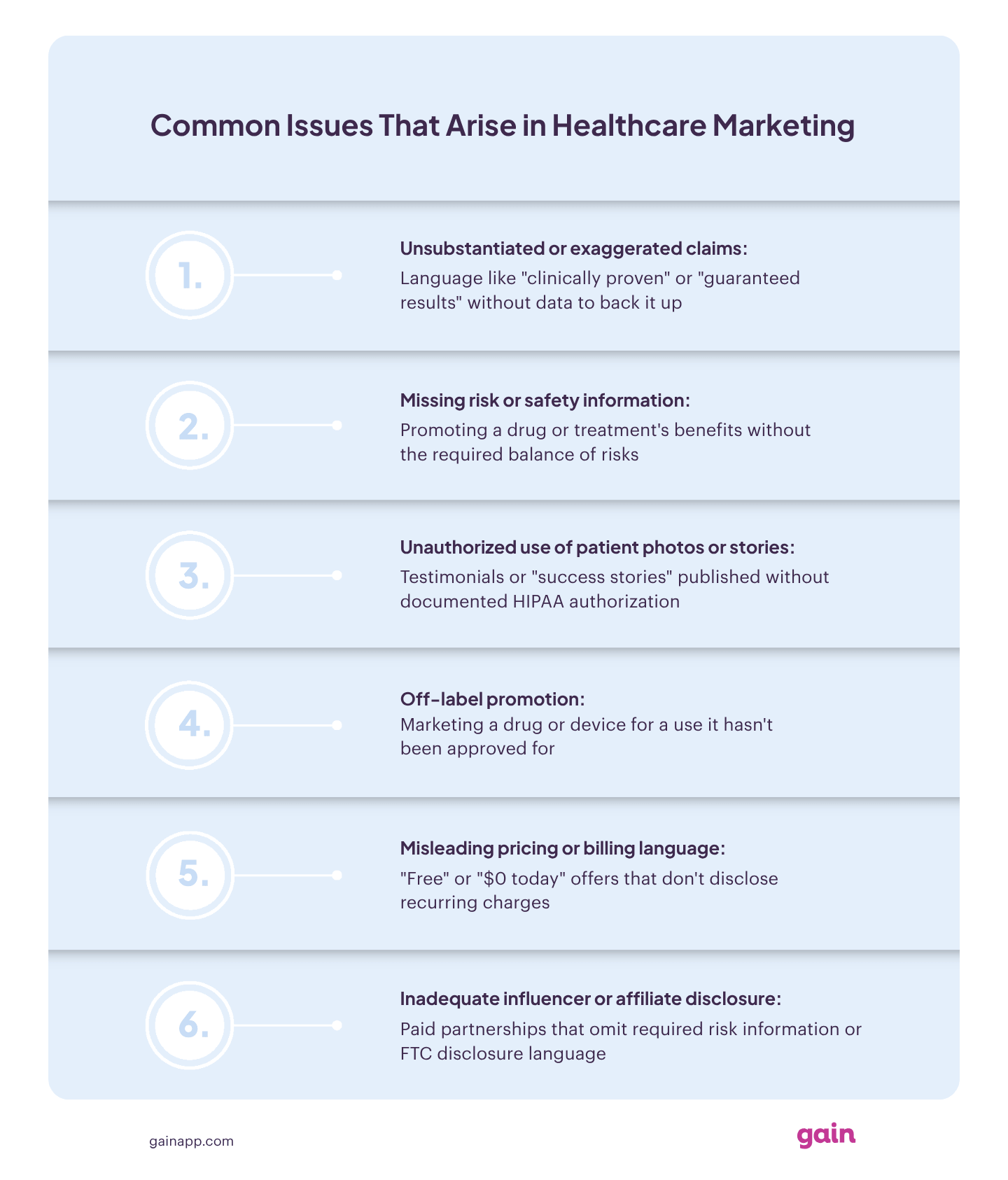
Most compliance problems in healthcare marketing fall into a handful of recurring categories. Knowing what to watch for is the first step to avoiding them:
- Unsubstantiated or exaggerated claims: Language like “clinically proven” or “guaranteed results” without data to back it up
- Missing risk or safety information: Promoting a drug or treatment’s benefits without the required balance of risks
- Unauthorized use of patient photos or stories: Testimonials or “success stories” published without documented HIPAA authorization
- Off-label promotion: Marketing a drug or device for a use it hasn’t been approved for
- Misleading pricing or billing language: “Free” or “$0 today” offers that don’t disclose recurring charges
- Inadequate influencer or affiliate disclosure: Paid partnerships that omit required risk information or FTC disclosure language
So, how do you make sure none of these things happen to your organization? Let’s look at a few strategies for minimizing potential risks.
5 Best Practices for Reducing Compliance Risk
Most healthcare marketing compliance problems can be prevented with a clear process. These five practices can help your team keep campaigns moving without taking unnecessary risks.
1. Back Up Every Claim Before Publishing
Phrases such as “clinically proven,” “doctor recommended,” and “fast-acting relief” may sound like standard marketing language, but regulators treat them as claims that require evidence. Any statement about a product’s safety, effectiveness, benefits, or expected results needs reliable support before it goes live.
The Federal Trade Commission has repeatedly taken action against weight-loss, wellness, and supplement companies over pricing and performance claims they couldn’t substantiate.
Set a simple rule for your team: If a claim can’t be tied to credible evidence or approved labeling, don’t publish it.
2. Protect Patient Privacy in Every Testimonial and Photo
Patient stories can be powerful marketing tools, but they also carry serious privacy risks. Under the Health Insurance Portability and Accountability Act, organizations subject to HIPAA generally need a patient’s written authorization before using identifiable health information, photos, or personal stories for marketing.
Before adding patient content to a campaign, confirm that the proper authorization has been signed and stored somewhere your team can easily retrieve it. Verbal permission or an assumption that the patient would be comfortable with the content isn’t enough.
3. Bring Legal and Compliance Review Into the Process Early
Some of the most expensive compliance mistakes happen when a fully developed campaign has to be changed or pulled because legal or compliance reviewers were involved too late.
Bring legal, regulatory, and medical reviewers in at the briefing or drafting stage, not right before publication. Early review gives them time to flag unsupported claims, missing disclosures, and privacy concerns before your team spends its full budget or the content reaches the public.
4. Train Your Marketing Team to Recognize the Risks
Most compliance mistakes aren’t deliberate. They happen because a copywriter, designer, or social media manager doesn’t realize that a phrase such as “guaranteed results” could draw regulatory scrutiny or that a patient screenshot requires authorization before it can be reused.
Compliance training should extend beyond the legal team. Teach marketers which rules apply to your organization, show them real examples of compliant and noncompliant content, and make it clear which materials require additional review.
💡Pro tip: Don’t forget to update the training regularly as healthcare regulations and internal policies change.
5. Maintain a Clear, Timestamped Audit Trail
Catching a problem before it becomes a much bigger issue beats defending it after the fact. That only works if you can see, at a glance, who reviewed a piece of content, what they flagged, and whether it was actually fixed before publishing. You need a record of:
- Every reviewer involved in the process
- Every change request
- Every sign-off with a timestamped audit log next to it
This can be difficult if you don’t have a proper content review and approval process. It’s even worse if you gather feedback via email or conversations in business communication apps and it isn’t properly documented. Ideally, you should have a structured content approval workflow to keep everything in one place, send content to the right reviewers, and record every decision along the way.
Gain is a content approval platform that helps marketing teams in regulated industries route marketing assets, including social media posts and PDFs, through customizable approval workflows before publication. Every review and approval is automatically recorded and timestamped, giving you a clear audit trail for claims and patient content before publishing.

Real-world Healthcare Marketing Examples That Backfired
Nothing shows the importance of healthcare marketing compliance more clearly than seeing what happens when brands get it wrong. The following cases show how unsupported claims, misleading promotions, and weak internal controls can quickly lead to regulatory action, financial penalties, and lasting reputational damage.
- Hims & Hers (2026): The FTC, joined by California and Utah, sued the telehealth company over ads promising “$0 today” for prescription consultations. The complaint alleges patients were charged and enrolled in recurring subscriptions the moment a provider wrote a prescription, with billing details buried in fine print, plus that the company shared sensitive health data with Meta and Snap despite marketing itself as privacy-protective. The case shows regulators will pursue major, well-known digital health brands.
- Sprout Pharmaceuticals (2025): The FDA issued a warning letter after the company’s own CEO posted false or misleading drug claims on her personal Instagram account, without the required risk information. Compliance risk doesn’t only live in ad campaigns; it lives anywhere an employee with a public profile talks about the product.
- Cadia Healthcare (2025): A Delaware nursing home chain paid $182,000 to settle with HHS’s Office for Civil Rights after posting patient names, photos, and treatment details on its website and social media as “success stories,” affecting roughly 150 patients, without proper authorization. A mandated corrective action plan and annual HIPAA training followed, along with the reputational damage of the story becoming news itself.
📚 Related Read: 12 Failed Social Media Campaigns (What Not To Do)
Laws Healthcare Marketers Should Know
The rules governing healthcare marketing vary depending on where your organization operates and where its audience is located.
Different countries have their own laws and regulatory bodies covering advertising claims, prescription drug promotion, medical devices, and the use of patient information.
Here are the main requirements healthcare marketers should know in the US, UK, Canada, and the European Union: ⬇️
- United States: The Food and Drug Administration (FDA) governs the promotion of prescription drugs and medical devices, while the Federal Trade Commission (FTC) takes action against deceptive claims under the FTC Act. The Health Insurance Portability and Accountability Act (HIPAA) also regulates how patient information can be used in marketing.
- United Kingdom: The Medicines and Healthcare products Regulatory Agency (MHRA) enforces the Human Medicines Regulations, which make advertising an unlicensed medicine a criminal offense. The Advertising Standards Authority (ASA) enforces the UK Code of Non-broadcast Advertising and Direct & Promotional Marketing (CAP Code), which prohibits advertising prescription-only medicines directly to the public.
- Canada: Health Canada regulates healthcare advertising under the Food and Drugs Act. The Pharmaceutical Advertising Advisory Board (PAAB) also reviews and preclears healthcare advertising aimed at medical professionals to help ensure its accuracy.
- European Union: Directive 2001/83/EC prohibits advertising prescription-only medicines to the general public while permitting promotion to healthcare professionals under stricter rules. The General Data Protection Regulation (GDPR) also sets requirements for collecting and using patient data in marketing.
FAQs
Yes, but only with a signed, specific authorization under HIPAA that covers how the patient’s information, photo, or story will be used. General consent for treatment doesn’t cover marketing use, and the authorization needs to be documented and retrievable.
The FDA regulates claims about prescription drugs and medical devices, focusing on a fair balance between benefits and risks. The FTC regulates deceptive or unsubstantiated advertising more broadly, including wellness products and healthcare services outside the FDA’s jurisdiction. Many healthcare companies need to satisfy both.
Staying Compliant Takes Active Effort on Your Part
Healthcare marketing compliance is easier to manage when it’s built into your workflow from the start. Back up every claim, protect patient information, involve the right reviewers early, and keep a clear record of every approval. These steps help your team catch problems before they turn into regulatory action, financial penalties, or damage to patient trust.
If you’re looking for a platform that supports compliant healthcare content workflows, try Gain for free today.