Insurance marketing has a lot in common with healthcare and finance marketing. You need to make a complex product sound clear and compelling without crossing any compliance lines.
That’s easier said than done. Behind every ad, email, brochure, and social post sits a web of federal rules, state regulations, carrier requirements, and platform policies. A missing disclosure, overenthusiastic savings claim, or post published before your legal team signs off can invite regulatory scrutiny and weaken customer trust.
The good news is that compliance doesn’t have to bring marketing to a standstill. In this guide, you’ll learn:
- What marketing compliance actually means in insurance
- The top compliance risks insurance marketers need to watch for
- How to build a review process that catches issues early and keeps campaigns moving
What Is Insurance Marketing Compliance?
Insurance marketing compliance is the process of ensuring that advertisements and promotional communications follow all applicable laws, regulations, carrier standards, and platform policies.
It applies to various types of content, such as:
- Websites
- Ads
- Social posts
- Emails
- Texts
- Print materials
- Videos
- Testimonials
- Influencer content
5 Common Insurance Marketing Compliance Risks
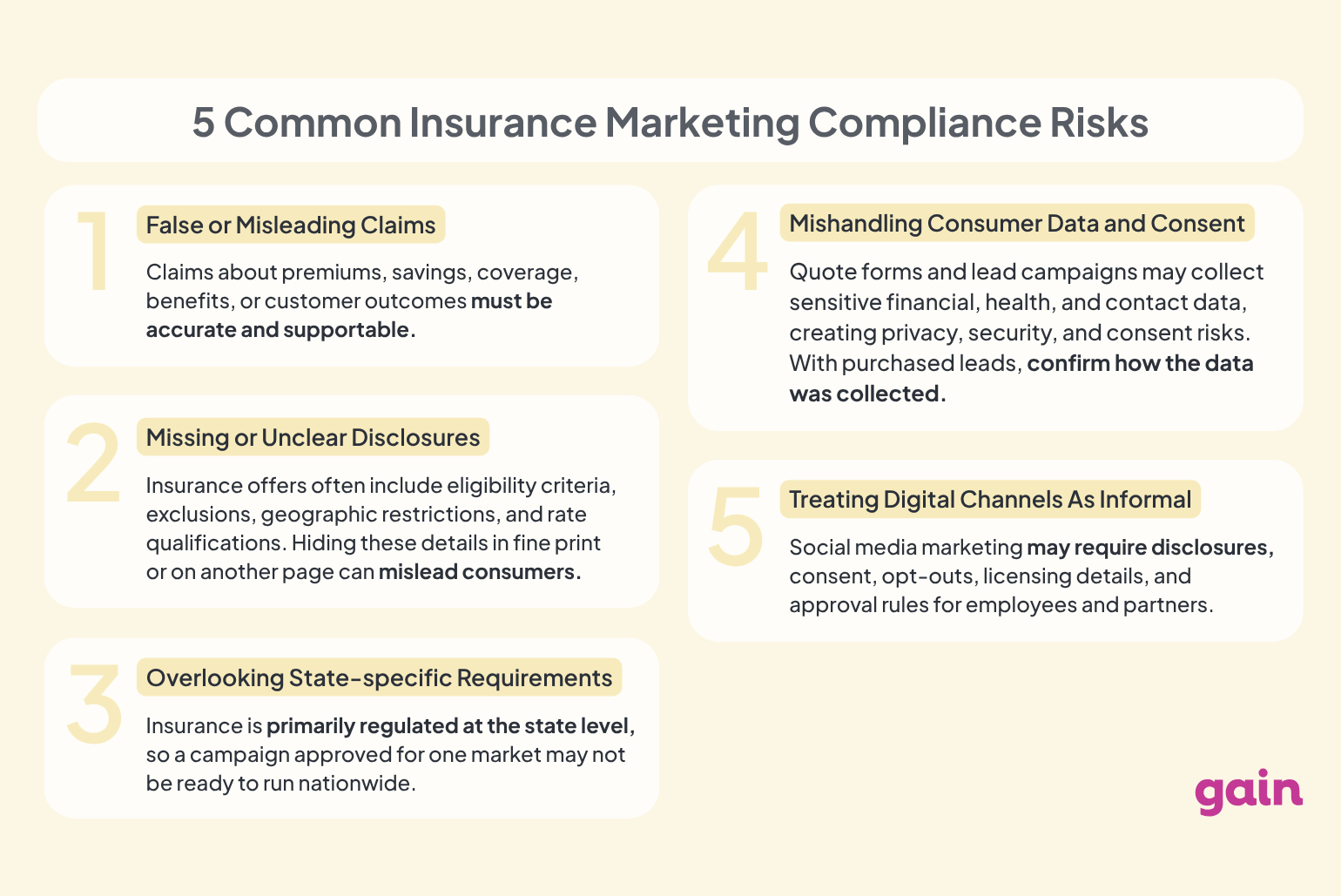
Requirements vary by product, state, audience, and marketing channel. However, most insurance marketing problems fall into five broad categories: ⬇️
1. False or Misleading Claims
Claims about premiums, savings, coverage, benefits, or customer outcomes must be accurate and supportable. Phrases such as “guaranteed approval,” “lowest rates,” or “everyone qualifies” can create problems when exceptions apply. Even technically true statements may mislead consumers if material information is omitted.
For example, in 2025, online insurance marketplace Assurance IQ and lead-generation company MediaAlpha agreed to pay a combined $145 million to settle FTC charges. The agency alleged that they misled people seeking comprehensive health insurance and directed some toward plans that didn’t provide the promised coverage.
2. Missing or Unclear Disclosures
Insurance offers often come with eligibility criteria, exclusions, geographic restrictions, and rate qualifications. Hiding these details in small text or on another page may leave consumers with the wrong impression. Worse? You could end up paying penalties.
In 2022, New York regulators found that Nationwide Life had failed to properly disclose income comparisons and suitability information during annuity replacement transactions. The company paid approximately $3.4 million in restitution and $2.24 million in penalties, then agreed to revise its disclosures, procedures, and training.
Disclosures should be readable, understandable, and placed where people will notice them.
3. Overlooking State-specific Requirements
Another risk? Ignoring state-specific requirements. Insurance is primarily regulated at the state level, so a campaign approved for one market may not be ready to run nationwide.
States can impose different advertising, disclosure, filing, licensing, and recordkeeping requirements. Agents and producers also need the appropriate licenses when marketing or selling particular products.
4. Mishandling Consumer Data and Consent
Quote forms and lead-generation campaigns may collect financial, health, contact, and other sensitive information. Risks include:
- Unclear privacy notices
- Unauthorized sharing
- Insecure handling
- Marketing beyond the scope of consent
With purchased leads, teams should establish how the data was collected and whether the consumer’s permission covers the planned calls, texts, or emails.
5. Treating Digital Channels As Informal
Short social posts, employee accounts, influencer videos, and direct messages are still marketing communications. Depending on the campaign, they may require sponsorship disclosures, opt-outs, consent, licensing information, or insurance disclosures. Clear guidelines and approval requirements should also cover agencies, agents, creators, and other partners.
What Laws Govern Insurance Marketing?
There’s no single federal law covering every insurance campaign. The applicable rules depend on the product, state, channel, audience, data, and technology.
These are some of the principal frameworks US marketing teams may encounter: ⬇️
| ❗Please note: This overview is general information, not legal advice. |
- State insurance laws and regulations: State insurance departments regulate advertising, misrepresentation, licensing, disclosures, and recordkeeping. The NAIC model laws and regulations include frameworks covering unfair trade practices and insurance advertising. The models aren’t laws by themselves, so teams must check each state’s enacted rules.
- CAN-SPAM Act: Commercial emails must use accurate routing information and nondeceptive subject lines, provide a postal address and opt-out method, and honor opt-outs. The FTC’s CAN-SPAM compliance guide explains the requirements.
- Telephone Consumer Protection Act: The TCPA and FCC rules restrict certain automated or prerecorded marketing calls and texts. Depending on the communication, prior express written consent and opt-out measures may be required.
- Gramm-Leach-Bliley Act: The GLBA requires covered financial institutions, including insurance companies, to explain certain data-sharing practices and protect sensitive customer information. See the FTC’s GLBA overview.
- HIPAA: Health plans and other covered entities generally need authorization to use or disclose protected health information for marketing, subject to limited exceptions. HHS provides detailed HIPAA marketing guidance.
Knowing the laws is one thing. Applying them consistently across every type of marketing content and communication is another. That requires an airtight content revision and approval process. Next, let’s look at how to set one up.
How to Reduce Insurance Marketing Compliance Risks Step by Step
Marketing compliance works best as a repeatable workflow. These steps will help you catch problems earlier and document each decision:👇
Step 1: Map the Campaign’s Requirements
Before anyone writes a headline or designs an ad, document the campaign in enough detail for the compliance team to assess it. Create a creative brief that identifies:
- The insurance product, carrier, offer, and claims you plan to make
- The target audience, including whether you are contacting prospects or existing policyholders
- Every state in which the campaign will run
- The channels and formats you plan to use
- Any lead sources, customer data, tracking tools, or marketing technology involved
These aren’t merely administrative details. Changing the product, audience, state, or channel can change which rules apply. A nationwide Medicare email campaign, for example, will require different checks than a state-specific auto insurance social post.
Share the creative brief with legal or compliance stakeholders and ask them to provide clear written guardrails. These should cover:
- Licensing
- Required disclosures
- Prohibited claims
- Consent
- State filing requirements
- The records that must be retained
Getting those answers early gives the creative team clear boundaries and prevents expensive revisions after a campaign has already been produced.
Step 2: Build an Approved Claims and Disclosures Library
Next up, consider building an approved claims and disclosures library. These libraries are especially helpful when several people create content for the same products or your team regularly reuses similar claims across campaigns.
In your approved claims library, include information such as:
- The exact approved claim or disclosure
- The evidence or source supporting it
- The products, states, and channels where it can be used
- Any qualifying language that must appear with it
💡Pro tip: Don’t treat the library as a set-it-and-forget-it resource. Assign someone to update it whenever products, rates, or regulations change, and clearly archive language that’s no longer approved.
Step 3: Create Channel-specific Checklists
Another way to reduce the risk of compliance issues is to use a checklist tailored to each marketing channel. Email, social media, paid ads, websites, print, video, and influencer content all come with different requirements. An email needs an unsubscribe method, for example, while an influencer post may need a sponsorship disclosure and a video may require disclosures on screen.
Each checklist should cover claims, disclosures, licensing, consent, privacy, content permissions, platform rules, geographic targeting, and accessibility. Requiring teams to complete the relevant checklist gives everyone the same minimum standards to follow, regardless of their role or experience, and makes important requirements less likely to be overlooked.
Step 4: Route Content Through a Structured Approval Workflow

A checklist only helps if the right people review content at the right time. Define a clear approval path for each content type, identifying who reviews first, who resolves conflicting feedback, and who gives final approval. Higher-risk campaigns may require marketing, product, compliance, legal, and carrier review, while lower-risk updates may follow a shorter path.
Once that sequence is established, a marketing content approval tool like Gain can help put it into practice. With Gain, insurance marketing teams can set up content approval workflows with multiple rounds, assign approvers, collect feedback and change requests, and secure final approval.
One of the biggest advantages is that you don’t need to chase reviewers manually, as Gain automatically sends reminders when feedback or approval is due. Role-specific permissions also let you control access, meaning each stakeholder sees only the content and features relevant to their role.
On top of it all, Gain keeps your files, feedback, revisions, and approval decisions together, reducing version confusion and creating a timestamped record right next to the content itself.
Step 5: Preserve The Supporting Evidence
Last but not least, you should preserve the evidence behind every campaign, even after the content has been approved and published. Keep the final creative alongside the sources used to substantiate claims, required disclosures, consent records, reviewer comments, approvals, publication details, and any later corrections.
Set retention periods based on applicable state regulations, the insurance product, carrier requirements, and your internal policies. Use consistent campaign names, tags, and version labels so records can be located by product, state, channel, or publication date.
📚 Related Read: How to Organize Marketing Materials and Assets Effectively
Wrapping Up
Insurance marketing will always involve risk. That’s why strong insurance marketing compliance can’t depend on someone remembering to perform a final check before publication. It needs to be built into the way content is planned, created, reviewed, approved, and stored.
Gain gives marketing, legal, and compliance stakeholders one place to review content, request changes, and record approvals. Start a free trial to replace scattered feedback with a clearer, more reliable content approval process.