
Photo by Tiger Lily on Pexels
In most industries, a poorly worded ad or a social media post is an embarrassment. In regulated industries, it can be a federal violation.
Financial services, healthcare, pharma, and insurance operate under strict rules that govern what you can say in your marketing, how you say it, who has to approve it, and how long you have to keep a record of it. Regulators actively monitor digital content and social media, and the past few years have produced some of the largest marketing-related enforcement actions ever seen.
In one SEC sweep focused specifically on Marketing Rule violations, nine registered investment advisers were charged for advertising hypothetical performance to the general public without required policies and procedures, resulting in $850,000 in combined penalties.
The stakes are high. But compliance doesn’t have to be a bottleneck. With the right practices in place, you can move fast, create great content, and still stay on the right side of the rules.
Here are 8 best practices to help you do exactly that. 👇
Which Industries Does This Apply To?
Before we get into the practices, a quick note on scope. Marketing compliance looks different depending on your industry and the regulators overseeing it.
In financial services, the key bodies are the SEC (Securities and Exchange Commission) and FINRA (Financial Industry Regulatory Authority). Broker-dealers fall under FINRA Rule 2210, which governs all communications with the public. Investment advisers are subject to the SEC Marketing Rule. In healthcare and pharma, the FDA regulates how drugs and medical devices are promoted, while the FTC polices deceptive claims across the board. Insurance marketing is governed at both the state and federal level.
The specific rules vary, but the underlying principles are consistent: content must be truthful, balanced, and properly reviewed before it goes live.
8 Best Practices for Marketing Compliance in Finance

1. Know Exactly Which Rules Apply to You
This sounds obvious, but it’s where many teams fall short. Compliance requirements aren’t one-size-fits-all, and assuming the rules that apply to one part of your business apply to all of it is a common and costly mistake.
For example, the FINRA Rule 2210 requires broker-dealers to ensure all public communications are fair, balanced, and free of misleading statements. Meanwhile, the SEC Marketing Rule prohibits investment advisers from making unsubstantiated claims, cherry-picking performance data, or including testimonials without proper disclosures.
Start by mapping the regulations that govern your specific business activities, channels, and audience. Then make sure your marketing team actually understands them — not just your legal team.
2. Build Compliance Into Your Content Process From the Start
The most expensive compliance mistake isn’t a rogue post. It’s a fully produced campaign that has to be pulled because no one looped in the legal team until the launch date.
Compliance review works best when it’s built into the content creation process from the beginning. This means involving legal, compliance, and regulatory reviewers early (ideally at the brief or concept stage), so that problems are caught before significant time and budget have been invested.
3. Get Everything Pre-approved Before It Goes Live
Pre-approval is a legal requirement in many regulated industries. Under FINRA Rule 2210, static promotional content must be approved by a registered principal before it’s used. The SEC Marketing Rule requires that advertisements be reviewed and approved before distribution.
For social media specifically, this creates real operational challenges. Platforms move fast, trends come and go, and a post that requires three rounds of legal review isn’t going to ride a news cycle. The answer isn’t to skip review — it’s to build a faster, more structured review process so approvals don’t become the bottleneck.
Pre-approval also protects you. If content is ever questioned by a regulator, being able to show that it went through a documented review process before publication is a significant line of defense.
4. Keep a Complete, Timestamped Audit Trail
Knowing that something was approved is one thing. Being able to prove it (with a record of who reviewed it, which version they saw, what feedback was given, and when the final sign-off happened) is another.
Regulators don’t shy away from auditing your processes. In financial services, firms are required to retain records of all marketing communications for no less than three years, depending on the rule and content type. The SEC has taken enforcement action against firms specifically for failing to maintain adequate records of their marketing materials.
A proper audit trail includes:
- Every version of a piece of content
- Every change request and revision
- Every approval decision
- A timestamp on all of the above
If your content approval process runs through email chains or Slack threads, you likely don’t have a defensible audit trail. You have a scattered conversation history that no regulator is going to find satisfying.
5. Train Your Marketing Team on the Rules
Most compliance failures aren’t intentional. They happen because creative and marketing teams genuinely don’t know where the lines are. A copywriter who has never worked in financial services might not know that “guaranteed returns” is a phrase that triggers FINRA scrutiny.
Regular compliance training for your marketing team isn’t optional in regulated industries. It should cover the specific rules that apply to your business, practical examples of compliant and non-compliant content, and clear guidance on what needs to go through review before anyone publishes it. Training should also be updated when regulations change, which they do.
The goal is to build a team that catches issues early rather than one that relies entirely on compliance review to do the work.
6. Vet Influencer and Third-party Content Carefully
Influencer marketing in regulated industries carries a specific risk that many teams underestimate: under FINRA’s doctrine of “entanglement” and “adoption,” if your firm was involved in creating an influencer’s content or subsequently endorsed it, that content becomes your marketing. The compliance obligations follow it.
The SEC and FINRA have been increasing enforcement around so-called finfluencers — social media creators who discuss financial products and investments to large audiences.
Before entering into any influencer or third-party content arrangement, you should review the influencer’s existing content, ensure any sponsored content meets all applicable disclosure requirements, and retain records of every piece of content produced under the partnership.
7. Use Clear, Consistent Disclosures
Required disclosures are only effective if people can actually see them. Regulators have been explicit about this: disclosures buried in fine print, hidden below the fold, or absent from social posts entirely don’t count as adequate disclosure.
In financial services, risk disclosures must accompany any claims about investment performance or potential returns, among other rules. It’s also important to apply disclosure standards consistently across every marketing channel you use. In other words, a compliant website means nothing if your Instagram posts are missing required language.
8. Have a Structured Content Approval Workflow, Not Just a Checklist
There’s a meaningful difference between having a compliance policy and having a compliance process. A policy tells your team what needs to happen. A process makes sure it actually happens, every time, for every piece of content.
In practice, this means using a system that routes content through the right reviewers automatically, tracks where every piece of content is in the approval process, and prevents anything from being published before it has the right sign-offs.
This is exactly what Gain is built for. Gain is a content approval platform used by marketing teams and agencies where social posts, files, and documents move through customizable approval workflows before anything goes live. Every review, change request, and sign-off is automatically documented with a timestamp, giving you a complete record of every approval decision across every piece of content.
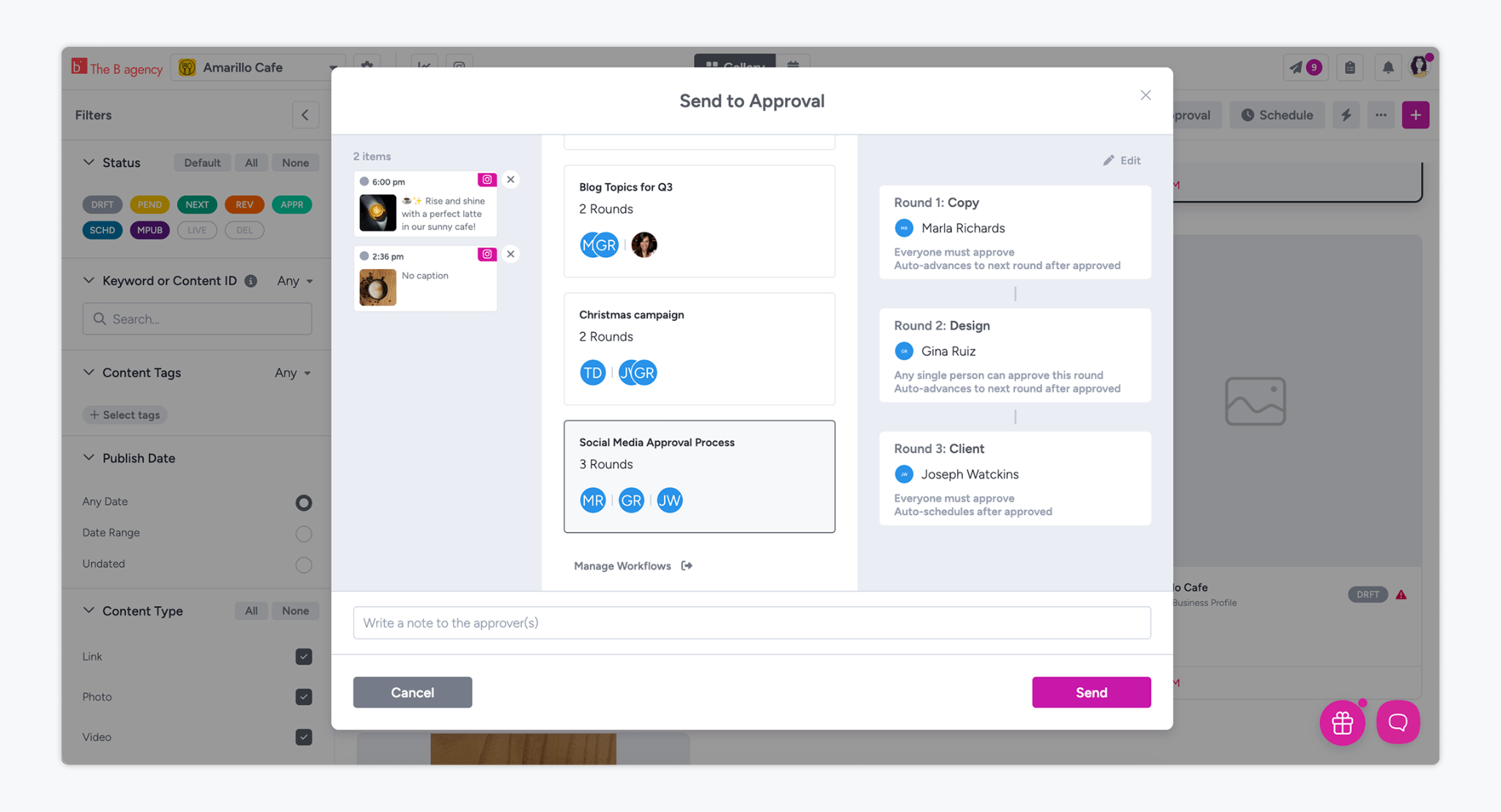
If you’re a team working in a regulated industry, Gain provides an audit trail for every piece of content you publish and helps you stay compliant.
FAQs
Legal review is one part of the broader marketing compliance process. Compliance covers the full picture: whether content meets regulatory requirements, how it was reviewed and approved, how long records are kept, and whether disclosures meet the required standards. Legal review typically focuses on liability and contractual risk. In regulated industries, you usually need both.
It depends on the industry and the specific rule. FINRA generally requires broker-dealers to retain records of communications for three years. SEC-registered investment advisers must retain advertising materials for five years. Some FDA record-keeping requirements extend to seven years. When in doubt, retain records longer rather than shorter.
Staying Compliant Is a Process, Not a One-time Fix
Marketing compliance in regulated industries isn’t a box you check at launch. It’s an ongoing operational discipline that requires clear processes, consistent training, structured review workflows, and thorough documentation.
The good news is that compliance and speed don’t have to be at odds. When the right processes are in place, reviews happen faster, fewer things get caught late, and your team spends less time chasing sign-offs and more time creating content that actually works.
If you’re looking for a platform that supports compliant content workflows, try Gain for free today.